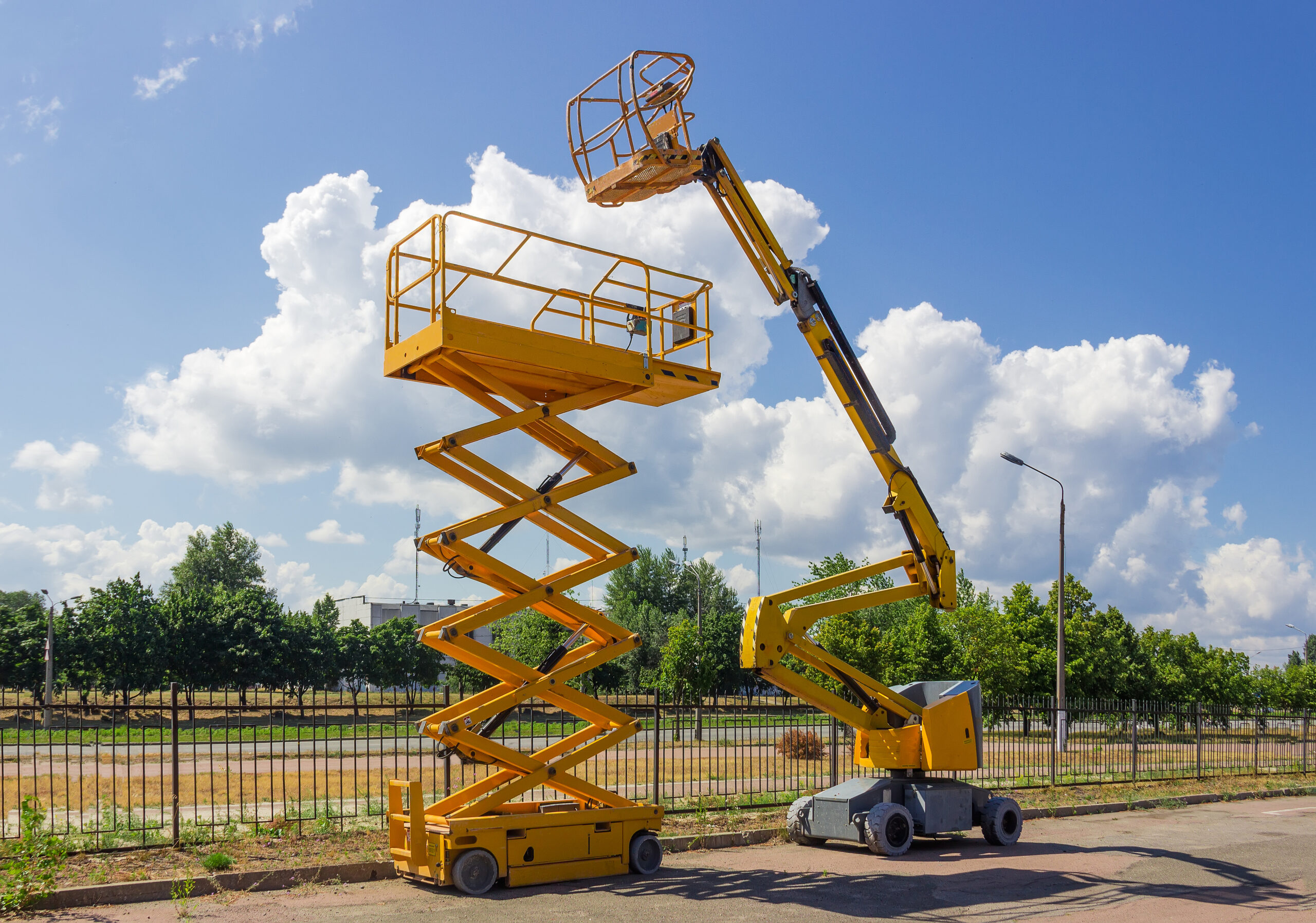
Here is the fact that makes most scissor lift pressure advice useless: the majority of scissor lifts in service have no tire pressure to check at all.
The electric slab machines that dominate warehouses, distribution centres and fit-out work run solid rubber tires. Solid rubber has no air cavity, no valve, and no pressure specification. If you have been searching for a PSI number for a GS-1932 or a 2632ES, the reason you cannot find a satisfying answer is that none exists — and any figure someone quotes you is either for a different machine or invented.
The pressure question is real, but it belongs to a specific minority of the fleet: rough-terrain (RT) scissor lifts and any machine on pneumatic or foam-filled tires. That is where pressure exists, where it changes machine behaviour, and where getting it wrong has safety consequences rather than just cost consequences.
This guide covers that minority properly — which machines have pressure, what the numbers look like, why inflation is a stability variable on a mobile elevating work platform rather than a comfort setting, and how to inspect a foam-filled casing that can never lose pressure but can still fail.
Which Scissor Lifts Have Tire Pressure to Check?
Start by identifying what your machine actually runs. The answer determines whether the rest of this article applies to you at all.
| Tire type | Does it have pressure? | Where you find it | What you check |
| Solid (non-marking or black) | No | Electric slab machines, most indoor fleets | Tread wear, chunking, bonding to the band — no gauge |
| Press-on solid | No | Cushion-chassis slab machines | Wear depth, band condition, hub fit |
| Pneumatic (air-filled) | Yes | Rough-terrain diesel machines | PSI against the manual, cold, on all four |
| Foam-filled | No, but the casing still matters | RT machines in high-puncture sites | Casing cuts, sidewall damage, foam integrity, bead area |
If your machine is in the top two rows, your maintenance schedule does not need a pressure step — it needs a wear inspection. Our companion article on what tire a scissor lift uses covers how each type is built, which explains why the pressure concept simply does not apply to a solid block of rubber.
If your machine is in the bottom two rows, pressure or its equivalent is a live variable every shift.
Why Pressure on a Scissor Lift Is Not a Comfort Setting
On a passenger car, tire pressure is mostly about wear, fuel economy and ride. On a rough-terrain scissor lift, it is a geometry and stability input, and the mechanism runs through four distinct paths.
1. Effective outer diameter. A pneumatic tire’s rolling radius is not fixed — it depends on how much the sidewall deflects under load. An underinflated tire has a smaller effective diameter than the same tire at spec. On a slab machine, pothole protection deploy bars are calibrated to a design height; the same calibration logic applies to RT machines with tilt and protection systems. Change the diameter and you change the margin the machine was designed around. Our buying guide covers the specification side of this in more detail; here the point is simply that pressure moves a dimension the machine cares about.
2. Contact footprint and ground pressure. Inflation pressure largely determines the shape and area of the contact patch. On soft ground — the exact surfaces RT machines are bought for — an overinflated tire concentrates load into a smaller footprint and sinks. A machine that bogs in gravel with correct pressure will bog sooner at 20 psi over spec.
3. Corner-to-corner balance. A machine that carries people at height is sensitive to asymmetry that a forklift would shrug off. One tire 15 psi low at a corner creates a lean and a different compliance response on that corner, which shows up on slopes and transitions rather than in a straight line on flat ground.
4. Heat and casing fatigue. The classic mechanism — underinflation means more sidewall deflection per revolution, more internal friction, more heat, earlier casing failure. On a machine that does short cycles with tight turns, that accumulates faster than the hour meter suggests.
The first three are why pressure on a MEWP is an engineering parameter. The fourth is why it still costs money if you ignore it.
Typical Pressure Ranges for Rough-Terrain Scissor Lift Tires
Rough-terrain scissor lifts run flotation-size pneumatic or foam-filled tires. Typical working ranges sit well below the 90-120 psi you would see on an industrial forklift, because the casing is designed to deflect and spread load rather than to resist it.
| Typical size | Common machine class | Indicative working range | Character |
26 x 12-16.5 |
RT scissor, 26-33 ft | ~55-90 psi | Most common RT scissor flotation size; broad range reflects load-rating differences |
33 x 15.5-16.5 |
Larger RT scissor, 40 ft class | ~50-80 psi | Larger volume, lower pressure per unit load |
12-16.5 (narrow rim) |
Compact RT and trailer-mounted | ~60-100 psi | Higher pressure band; check per load rating |
240/55-10 (metric) |
Some global-build slab and RT | Per manual — often higher | Metric-flotation convention; do not cross-convert from inch figures |
Read this before using the table. These are indicative ranges for orientation, not specifications. Pressure on a pneumatic tire is a function of load rating and ply, not of size alone — two tires with the same marking can carry different ratings and require different pressure. The authority is the machine manual for your serial number, together with the load-inflation tables published by ETRTO in Europe and the Tire and Rim Association in the US. Never inflate to a number from an article, including this one, without confirming it against the plate or the manual.
If you are moving between a forklift and an RT scissor lift in the same yard, note that the pressures are not comparable — the reasoning behind industrial forklift pressures is covered in our forklift tire pressure chart and it does not transfer.
What Wrong Pressure Actually Does on a MEWP
| Condition | Mechanism | What you observe | What it costs |
| Underinflation | Excessive sidewall deflection, heat build-up, reduced effective diameter | Squat stance, hot sidewalls after a shift, sluggish steering, sidewall cracking at the flex zone | Casing failure, reduced platform height margin, early replacement |
| Overinflation | Reduced footprint, concentrated load, harsher impact transmission | Hard ride, centre-tread wear, poor traction on gravel, sinking on soft ground | Traction loss, bogging, impact damage to the casing and to the machine |
| Uneven left-right | Asymmetric compliance and effective diameter | Visible lean with the platform raised, different behaviour turning left versus right on a slope | Stability margin reduced on the side that matters most |
| Uneven front-rear | Load transfer changes with platform extension | Nose-up or nose-down attitude, altered steering feel when fully extended | Reduced margin at full extension, where load is highest |
The last two rows are the ones worth taking seriously. A forklift with one soft tire handles badly. A scissor lift with one soft tire has a raised platform on a reduced stability margin — and the operator is standing on it.
Temperature and Environment
Pressure moves with temperature, and RT scissor lifts live outdoors, which makes this more than a theoretical concern. The rule of thumb is roughly 1 psi per 10°C of ambient change, which means a machine checked on a warm afternoon and then used on a cold morning is meaningfully low before it has done any work.
Two practical consequences:
- Check cold. Measure before the first shift, not after a run. A hot tire reads high and will mislead you into letting it run low.
- Seasonal resets are real. Machines that sit through a cold season need a pressure check before returning to service, not after the first week of complaints.
Cold environments add a further layer — rubber hardens, compliance drops, and the tire behaves differently from the pressure table’s assumption. That interaction is covered in our cold storage forklift tire guide, and the general failure mechanisms in our OTR tire failure analysis.
Foam-Filled Tires: No Pressure to Check, but the Casing Still Fails
This is the part most operators get wrong, and it is worth stating precisely.
A foam-filled tire has had its air cavity filled with a polyurethane foam that cures into a semi-rigid core. It cannot go flat in the ordinary sense — a puncture does not deflate it, because there is no pressurised gas to escape. That is why foam fill is specified on RT machines working demolition, recycling, and sites where punctures would otherwise stop the machine.
But foam fill changes one failure mode, it does not remove the others. The casing is still a rubber-and-cord pneumatic casing, and it can still be cut, torn, overheated and destroyed. What you lose when you fit foam is the warning signal — there is no slow leak, no low-pressure symptom, no gradual degradation you can measure with a gauge. Damage goes from “detected” to “discovered.”
Inspect a foam-filled tire as a casing, not as a solid:
- Sidewall cuts and snags — the leading failure cause; foam does not protect the rubber from sharp edges
- Tread chunking and tearing — indicates either abuse or a compound mismatch for the surface
- Bead area condition — separation here is a fitment or overload symptom, not a puncture symptom
- Signs of overheating — discolouration, hardening, a burnt smell; foam-filled tires can overheat internally because heat has no easy path out
- Foam integrity at damage sites — exposed or crumbling foam means water ingress is now a risk
- Circumferential uniformity — check for flat spots from long stationary periods under load
The trade-off between solid, foam-filled and pneumatic on these machines — including where foam is the wrong answer — is covered in our solid versus foam-filled comparison.
A Pressure Routine That Fits a Real Site
| Frequency | Action | Notes |
| Pre-shift (each shift) | Walk-around: visual check for damage, squat stance, debris in the tread | Two minutes; catches the majority of developing failures |
| Daily to weekly | Gauge check on all pneumatic tires, cold | Match the interval to duty intensity and site hazard; demolition sites need the shorter end |
| Weekly | Compare across the four corners and record the numbers | Trends catch slow leaks a single reading misses |
| Monthly | Inspect foam-filled casings for cuts and bead condition | No gauge involved — this is a visual and tactile inspection |
| Seasonally | Full reset to spec; adjust for temperature shift | Especially after a machine has been parked through a cold period |
| On any tire change | Verify the replacement matches the marking, load rating and diameter tolerance | See our size guide for reading the marking correctly |
Record the readings. A pressure log is the cheapest diagnostic tool in a fleet: two consecutive readings drifting on one corner tells you there is a slow leak or a damaged valve long before it becomes a roadside failure. Casing management and cost-per-hour economics in industrial tire fleets are tracked closely in Tyrepress‘ industry reporting, and the pattern is consistent — the fleets that measure, spend less.
FAQ
What tire pressure should a scissor lift run? It depends entirely on the tire type. Solid and press-on tires have no pressure specification at all — the majority of electric slab scissor lifts fall in this group. Pneumatic and foam-filled tires on rough-terrain machines do have a specification, typically in the 50-100 psi range by size and load rating. Confirm against the manual for your serial number.
Do solid scissor lift tires need pressure checks? No. Solid rubber tires have no air cavity, so there is nothing to inflate or measure. They need wear and damage inspection instead — tread depth, chunking, and the bond to the steel band.
How often should rough-terrain scissor lift tire pressure be checked? At minimum weekly with a gauge, checked cold before the first shift, plus a visual walk-around every shift. Demolition, recycling and other high-hazard sites warrant daily gauge checks.
Can a foam-filled tire go flat? No — that is the point of foam fill. But it can still be cut, torn, overheated or destroyed, and you get no low-pressure warning first. Inspect the casing visually rather than relying on a gauge.
Does tire pressure affect scissor lift stability? Yes. On a MEWP, pressure changes effective outer diameter, contact footprint and corner-to-corner balance — all of which feed into the stability margin when the platform is raised. It is a stability parameter, not a comfort setting.
Why does my scissor lift lean to one side? Uneven tire pressure is a common cause on pneumatic machines, along with uneven wear and a damaged casing. Check all four cold and compare the readings before assuming a mechanical fault.
Should I run higher pressure for better fuel economy? Not on a rough-terrain scissor lift. Overinflation reduces the contact footprint, which hurts traction and makes the machine sink on soft ground — exactly the surfaces RT machines work on. Fuel saving is not the objective here; stability and traction are.
Can I fit solid tires to replace worn pneumatic tires on an RT machine? That is a change to the machine’s compliance and stability behaviour, and it belongs to the manufacturer, not to a purchasing decision. RT machines are engineered around pneumatic or foam-filled tires. If punctures are your problem, the answer is foam fill, not a change of category — see our tire type guide.