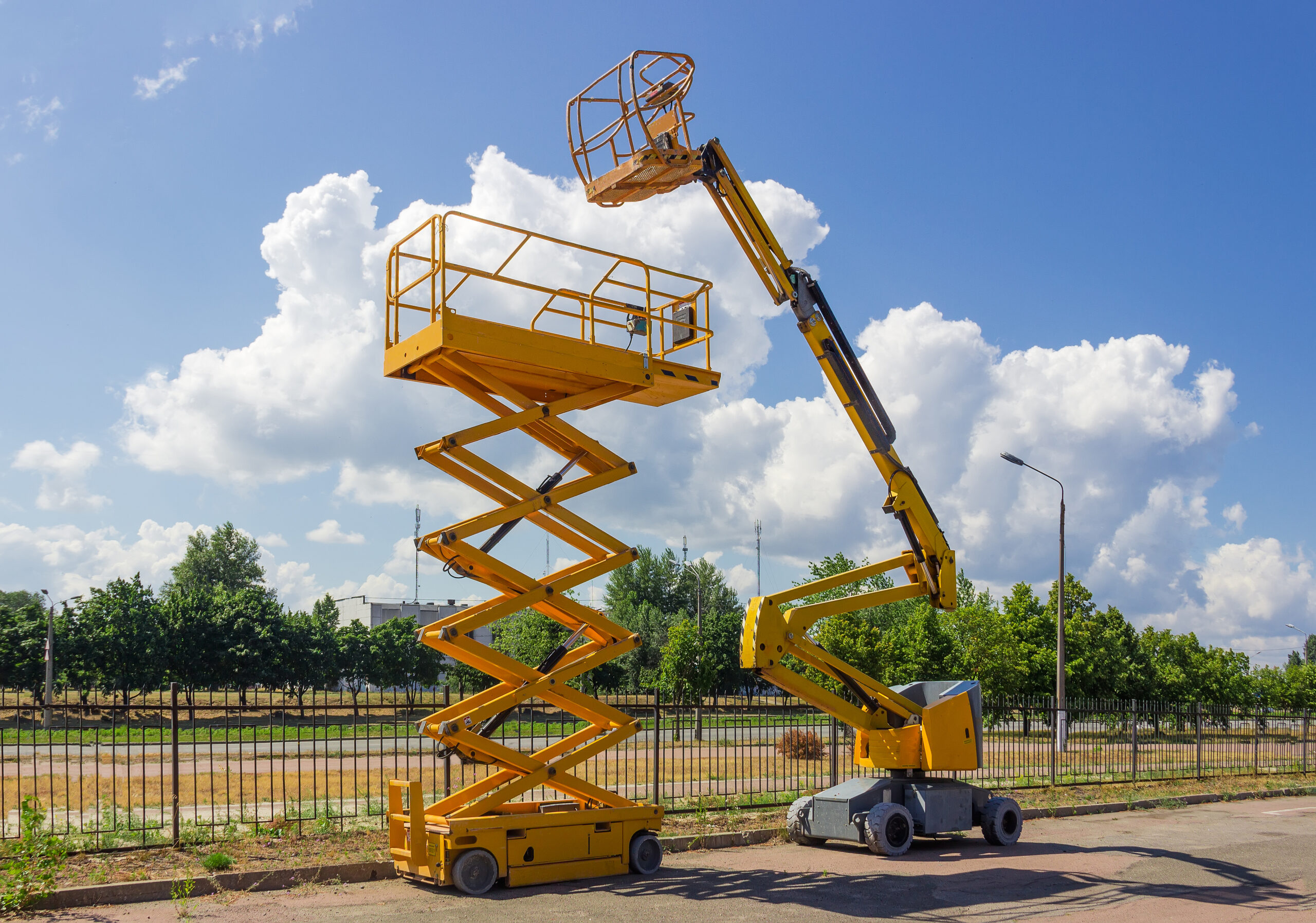
On almost every machine category, a tire is a wear item: it wears out, you replace it, and the specification matters mostly for cost per hour. A scissor lift is different. On a mobile elevating work platform, the tires are part of the stability system — they set platform height, affect whether the machine’s pothole protection deploys correctly, and determine the contact geometry that keeps a raised platform with a person on it upright.
That is why the most expensive scissor lift tire mistake is not the one that wears out early. It is the one where a “close enough” size, a mismatched load rating, or a single replacement tire quietly changes the machine’s behaviour — usually without any obvious symptom until the day it matters.
This guide covers what to buy, how to specify it, what not to do, and how to evaluate a supplier for this category. If you want the construction-level answer to “what exactly is on this machine and why,” that is covered separately in our scissor lift tire types guide.
Start with the machine class, not the tire
Every scissor lift purchase decision begins from one question: slab or rough terrain? Everything downstream follows from it.
| Machine class | Typical duty | Dominant tire type | Why |
| Electric slab scissor (e.g. 19-33 ft class) | Indoor finished floors, warehouses, fit-out | Non-marking solid | No puncture risk, no pressure maintenance, no floor marking |
| Large electric slab (e.g. 40 ft class) | Indoor and smooth outdoor yards | Non-marking or black solid | Higher load, longer duty cycles |
| Rough terrain scissor (diesel, 4×4) | Construction sites, unpaved ground | Pneumatic or foam-filled | Needs shock absorption and grip that solids cannot give |
| Compact / push-around units | Light indoor maintenance | Small solid or polyurethane | Low speed, low duty |
The rough-terrain row is where buyers go wrong most often. Those machines are engineered around pneumatic tires: the suspension, ride height, and stability envelope assume a compliant tire. Fitting solids to a rough-terrain scissor because “punctures are annoying” changes how the machine reacts on uneven ground — a decision that belongs to the manufacturer, not to a purchasing shortcut.
Tire types, and what each actually buys you
| Type | Construction | Best for | Limitations |
| Non-marking solid | Solid rubber ring with light-coloured fillers | Finished indoor floors where black marks are a cost or a lease violation | Firm ride; poor on rough ground; compound drives life |
| Black solid | Same construction, carbon-black compound | Industrial floors where marking does not matter, outdoor yards | Marks light-coloured floors; heat-limited in heavy duty |
| Pneumatic | Air-inflated casing | Rough terrain machines, uneven ground | Puncture exposure, pressure maintenance required |
| Foam-filled pneumatic | Pneumatic casing filled with elastomer instead of air | Rough terrain sites with heavy debris where flats are costly | Heavier, firmer ride, and must be specified against the machine’s load data — not a field improvisation |
| Polyurethane / microcellular | Cast elastomer | Specific high-load, low-speed, smooth-floor applications | Lower grip, impact-sensitive; niche in this category |
The compound question for scissor lifts mirrors the one for forklifts: marking behaviour is a compound property, not a category property, and the reasoning is identical to what we cover in our non-marking tire guide. For indoor slab machines, non-marking is the default for a good reason — floor remediation on a finished surface costs far more than the tire premium.
Sizes: how to read the marking, and why tolerance matters
Scissor lift tires appear in several marking conventions, which is one reason ordering goes wrong.
| Marking style | Example | Reading |
| Three-number inch | 12 x 4.5-8 |
Outer diameter × width × rim/band diameter |
| Three-number with fraction | 12 x 4½ x 8 |
Same, written fractionally |
| Metric-flotation | 240/55-10 |
Section width mm / aspect ratio % / rim diameter in |
| Flotation inch | 26 x 12-16.5 |
Outer diameter × width × rim diameter — common on rough terrain |
Typical sizes cluster by machine class, and these are indicative only — the machine’s manual and the tire sidewall are the authority:
| Machine class | Commonly seen sizes (indicative) |
| Compact electric slab | 12 x 4.5-8, 240/55-10 |
| Mid-size electric slab (26-33 ft) | 15 x 5-11, 16 x 6-10, 240/55-10 |
| Large electric slab (40 ft+) | 16 x 6-10, 27 x 10-12 and similar |
| Rough terrain scissor | 26 x 12-16.5, 33 x 15.5-16.5, 12-16.5 |
Two tolerance rules matter more than the numbers themselves:
- Outer diameter is a functional dimension, not a fitment dimension. On many slab machines, the pothole protection mechanism is calibrated to tire diameter — deploy bars that engage at a designed height. A tire with the wrong outer diameter, even if it mounts, can change when or whether that system engages correctly.
- Load rating must meet or exceed the machine’s specification. Two tires with identical markings can carry different ratings by ply/construction. Purchase against the rating, not the marking alone.
Where dimensional and load standards are concerned, the Tire and Rim Association and ETRTO publish the reference tables manufacturers work from; a supplier quote that cannot trace its load figures back to a recognised standard deserves a second question.
The full-set rule
This is the single most important operational policy in the category, and it is the one most often broken for cost reasons.
Replace scissor lift tires as a complete set, and never mix types on one machine.
The reasons are mechanical, not commercial:
- Platform level and height. Mixed tire diameters across corners tilt the platform and shift the machine’s effective working height. On a raised platform, small geometric changes are felt at the top of the mast.
- Uneven load sharing. A new tire alongside a worn one carries load differently, overloading its neighbour.
- Stability behaviour. Rough-terrain machines with different compliance at each corner behave unpredictably on slopes and transitions.
- Mixed constructions. A solid on one corner and a pneumatic on another produce two different suspension rates on the same chassis.
A fleet that replaces one tire at a time to save a quarter of the invoice is borrowing from the safety margin. Buy sets, and budget for them.
Seven criteria for specifying the right tire
- Identify the machine exactly — manufacturer, model, and serial range. Scissor lift models get re-tired across production years; the manual for your serial range is the authority.
- Read the existing tire marking and photograph it. Do not rely on a model-level assumption.
- Confirm the load rating requirement, not just the size. Meet or exceed OEM.
- Match the type to the ground. Finished floor → non-marking solid. Rough terrain → pneumatic or foam-filled as specified by the manufacturer.
- Verify outer diameter tolerance with the supplier — particularly on machines with pothole protection.
- Decide compound by floor economics. On finished floors, non-marking is almost always cheaper than the remediation.
- Plan for set replacement and availability. A machine out of service waiting for one tire costs more than keeping a set on the shelf — store spares correctly using the rules in our OTR tire storage guide.
How to evaluate a scissor lift tire supplier
Because this is a safety-adjacent purchase, the supplier criteria are stricter than for a general industrial tire.
| Criterion | What to ask for |
| Dimensional documentation | Outer diameter, section width, and tolerance in writing — not “fits model X” |
| Load rating traceability | Rating stated against a recognised standard (TRA / ETRTO), with ply or construction specified |
| Compound specification | Marking behaviour, heat and abrasion class, temperature range if relevant |
| Batch consistency | Evidence of compound consistency across production runs — the classic weak point in low-cost sourcing |
| Set availability | Ability to supply complete matched sets, and lead time for repeat orders |
| Technical support | Willingness to confirm a specification against your machine before shipping, rather than after |
That last row is the real discriminator. A supplier who will only quote a size, and will not engage with load rating or diameter tolerance, is selling a commodity tire into a stability application. Our OTR tire supplier evaluation framework covers these questions in broader form, and our manufacturer evaluation guide explains how to read capability claims.
Six mistakes that create real exposure
| Mistake | Why it is dangerous |
| Buying by size, ignoring load rating | A physically correct tire with an insufficient rating can fail under load at height |
| Replacing a single tire | Tilts the platform, overloads the neighbour, breaks load symmetry |
| Mixing types on one machine | Two suspension rates on one chassis; unpredictable on transitions and slopes |
| Assuming an aftermarket tire is dimensionally identical | Outer diameter tolerance can shift pothole protection engagement and platform height |
| Fitting black compound on finished floors | Remediation costs dwarf any saving |
| Foam-filling pneumatics without checking the load data | Changes mass, ride, and compliance — a manufacturer-level decision, not a field one |
Every row in that table is a decision that looks like a procurement saving and behaves like an engineering change.
Tire condition and correct fitment sit at the top of every serious industrial tire-safety programme — the U.S. Tire Manufacturers Association places proper specification, inflation where applicable, and condition inspection ahead of everything else, and that hierarchy applies with more force on a machine carrying a person at height than anywhere else.
Cost: why unit price is the wrong metric
Scissor lift tires are a low-frequency, high-consequence purchase. The honest cost model has four lines:
- Purchase price per set — the visible number, and the least informative one.
- Service life in hours — driven mainly by compound and floor condition.
- Machine downtime — a MEWP out of service is a crew idle, which typically dwarfs the tire cost on any active site.
- Risk cost — the one that cannot be invoiced, and the reason specification discipline exists.
A set that costs 30% more and lasts twice as long is cheaper on lines 1-3. A set that is specified incorrectly is expensive regardless of what it cost.
FAQ
What tires do scissor lifts use? It depends on the class. Electric slab scissor lifts typically use non-marking solid tires; rough-terrain diesel machines use pneumatic or foam-filled tires. The machine manual and the existing sidewall marking are the authority — not the model name alone.
Can I replace just one tire on a scissor lift? You should not. Mixed tire diameters and wear levels tilt the platform, shift working height, and change load distribution. Replace complete sets.
What do scissor lift tire size markings mean? Common styles include three-number inch (12 x 4.5-8: outer diameter × width × rim diameter), metric-flotation (240/55-10), and flotation inch (26 x 12-16.5). Always match the marking on the existing tire and confirm against the machine manual.
Are non-marking tires worth it on a scissor lift? On finished indoor floors, almost always yes. Black compound marks are expensive to remediate and are frequently a lease or handover condition. On outdoor or industrial floors, black compound is usually the better value.
Can I put solid tires on a rough-terrain scissor lift? Not as a substitution decision. Rough-terrain machines are engineered around pneumatic compliance for stability on uneven ground. Changing that is a manufacturer-level specification change, not a purchasing preference.
How long do scissor lift tires last? Highly dependent on floor condition, duty cycle, and compound. Indoor slab machines on smooth floors can run for years; rough-terrain machines on abrasive sites wear far faster. Replace on wear-limit and condition inspection rather than on a calendar.
Do scissor lift tires need pressure checks? Pneumatic and foam-filled types do — the pressure maintenance rules in our forklift tire pressure guide apply by analogy. Solid and press-on types contain no air and need no pressure checks.
Should I buy OEM tires or aftermarket? Both are viable. What matters is whether the aftermarket tire documents its dimensions, tolerance, and load rating against a recognised standard, and whether the supplier will confirm the specification against your serial range before shipping.
Key takeaways
- On a scissor lift, tires are part of the stability system — specification is a safety decision before it is a cost decision.
- Start from machine class: slab machines take non-marking solids; rough-terrain machines take pneumatic or foam-filled as the manufacturer specifies.
- Specify by size + outer diameter tolerance + load rating, sourced from the manual and sidewall, not from a model-level assumption.
- Replace complete sets. Never mix types, diameters, or wear levels on one machine.
- Evaluate suppliers on documented dimensions, load-rating traceability, batch consistency, and willingness to confirm your spec — not on unit price.
- Judge cost across purchase price, service life, machine downtime, and risk. Unit price is the least informative of the four.
Send us your machine make, model, and serial range, plus the floor and duty description, and our team will confirm the correct specification — including diameter tolerance and load rating — before you order. Contact our tire specialists with the details, or browse our scissor lift tire range for the common sizes and compounds.