
Order the wrong tire size and you will know it the moment you try to mount it — the bead won’t seat, the rim is too wide or too narrow, and the machine sits idle. Wheel loader tire sizes are not interchangeable across models, and the numbering system can be confusing if you have never decoded it. This guide walks you through how to read loader tire sizes, match them to your machine, and choose the right construction and tread depth so you order correctly the first time.
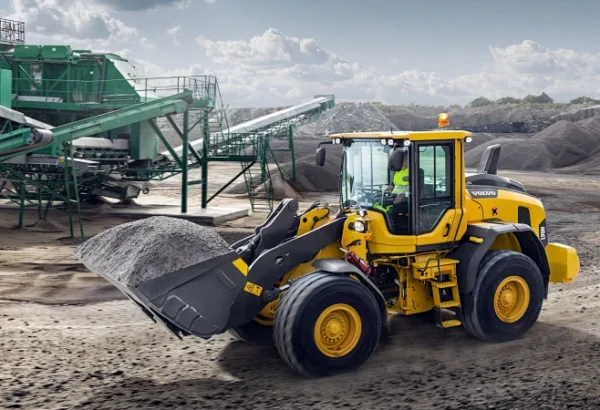
The size stamped on the sidewall is your starting point — but it is not the only factor in choosing the right tire.
What Tire Sizes Do Wheel Loaders Use?
Wheel loaders span a wide range of operating weights, from compact 5-ton machines to 50-ton-plus production loaders. Each weight class uses a different tire size. The most common sizes are:
| Loader Weight Class | Typical Tire Size (Bias) | Typical Tire Size (Radial) | Example Loader Models |
| Compact (5-8 t) | 17.5-25 | 445/70-25 | Cat 906, Volvo L60H |
| Small (10-12 t) | 20.5-25 | 525/70-25 | Cat 950, Komatsu WA270 |
| Medium (15-18 t) | 23.5-25 | 65/35-33 | Cat 966, Komatsu WA380 |
| Large (20-25 t) | 26.5-25 | 26.5R25 | Cat 972, Komatsu WA470 |
| Extra-large (30-40 t) | 29.5-25 | 29.5R25 | Cat 980, Komatsu WA500 |
| Production (40 t+) | 35/65-33 | 35/65R33 | Cat 988, Komatsu WA600 |
| Mining (50 t+) | 45/65-45 | 45/65R45 | Cat 992, Komatsu WA1200 |
This chart is a starting point — always verify the size stamped on your current tire’s sidewall or check the machine’s operator manual. A mismatched tire can damage the rim, overload the axle, or rub against the loader frame at full steering lock.
How to Read a Loader Tire Size Like “23.5-25”
Loader tire sizes use a two-part numbering system separated by a dash or the letter “R”:
- First number (23.5) — the tire’s section width in inches. This is the width of the inflated tire at its widest point, not the tread width.
- Second number (25) — the rim diameter in inches. A 23.5-25 tire fits a 25-inch rim.
- “R” instead of “-“ (e.g., 26.5R25) — indicates radial construction. A dash means bias construction.
Some sizes use a metric format (e.g., 65/35-33). In this notation:
- 65 — section width in centimeters
- 35 — aspect ratio (sidewall height as a percentage of width)
- 33 — rim diameter in inches
These numbering systems follow the dimension and load standards published by the Tire and Rim Association (TRA) and ETRTO. When you order, quote the full size exactly as stamped — including the dash, R, or metric format — to avoid receiving the wrong tire. For a broader overview of off-highway tire categories, see our guide on what an OTR tire is.
How to Match Tire Size to Your Loader Model
Follow this process to confirm the correct size:
- Check the sidewall of the current tire. The size is molded into the rubber, typically on the outer sidewall. Write it down exactly: “23.5-25” not “23.5×25” or “235-25.”
- Verify the rim size. The rim diameter must match the tire’s second number. A 23.5-25 tire requires a 25-inch rim — putting it on a 25-inch rim sounds obvious, but some loaders have been retrofitted with non-standard rims.
- Confirm the ply rating or load index. A 23.5-25 tire comes in different ply ratings (e.g., 16-ply, 20-ply). Your loader’s maximum axle load determines the minimum ply rating. Check the machine manual for the required load capacity per tire.
- Consider upgrading from bias to radial. If your current bias tire is 23.5-25, the radial equivalent may be 65/35-33 — not 23.5R25. Radial conversions sometimes change the overall tire diameter, so verify that the radial size clears the fender and steering envelope. Contact our tire specialists if you need help confirming a bias-to-radial conversion.
- Check for non-standard markings. Some OEMs use proprietary size codes. For example, certain Bobcat and Volvo compact loaders use sizes like 10-16.5 or 12-16.5 that follow a different convention. When in doubt, provide the loader model number and year to your supplier.
Radial vs Bias Loader Tires: Which Construction Is Right?
Both constructions are available in most loader sizes, but they serve different working conditions:
| Factor | Radial Loader Tire | Bias Loader Tire |
| Construction | Steel belts at 90° to tread centerline | Diagonal nylon plies |
| Heat dissipation | Excellent — runs cooler at higher speeds | Moderate — heat builds up faster |
| Tread wear | Slower, more even | Faster, especially in the center |
| Sidewall cut resistance | Moderate — sidewall is more flexible | High — thick, stiff sidewall |
| Traction | Superior, larger contact patch | Good, but smaller footprint |
| Ride comfort | Softer ride, less machine vibration | Stiffer, transmits more shock to the axle |
| Fuel efficiency | Better — lower rolling resistance | Higher rolling resistance |
| Upfront cost | Higher (20-40% more) | Lower |
| Best for | Long cycles, higher speeds, mixed surfaces | Short cycles, slow speed, rock/heavy debris |
| Retreadability | High — strong casing ideal for retreading | Moderate — casing wears with use |
Rule of thumb: Choose radial if your loader runs long haul cycles (loading trucks, stockpile work) at speeds above 15 km/h. Choose bias if the loader works in a stationary rock face or quarry floor at low speed where sidewall cuts are the primary failure mode. Browse our loader tire range to compare both options.
L3 vs L4 vs L5: Which Tread Depth Do You Need?
After size and construction, the tread depth designation is the third decision. The L-series (Loader service) codes indicate tread depth:
| Code | Tread Depth | Best Application | Wear Life |
| L3 | Standard (100% depth) | Gravel, sand, mixed surfaces | Baseline |
| L4 | Deep (150% of L3) | Sharp rock, quarry floor, moderate cut risk | 1.5x L3 |
| L5 | Extra-deep (250% of L3) | Severe rock, high cut risk, slow speed only | 2.5x L3, but generates more heat |
| L5S | Smooth (solid, no lugs) | Scrap yards, metal recycling | No tread to tear off |
Key trade-off: deeper tread lasts longer but generates more heat. L5 tires should not be run at speeds above 10 km/h for extended periods — the extra rubber mass cannot shed heat fast enough, leading to heat separation. If your loader runs at highway-adjacent speeds between sites, stick with L3 or L4.
According to industry coverage by Tyrepress, choosing a tread depth one grade too high is a common mistake — fleet managers see the deeper tread and assume it is always better, but heat failures on L5 tires in high-speed applications are a frequent warranty rejection.
Common Loader Tire Sizing Mistakes
Mistake 1: Ordering by section width only. A 23.5-25 and a 23.5-22.5 have the same width but different rim diameters. The tire will not fit the rim.
Mistake 2: Assuming bias and radial equivalents are the same diameter. Converting a 26.5-25 bias to a 26.5R25 radial is usually fine, but converting a 23.5-25 bias to a 65/35-33 radial changes the overall diameter. Always check clearance.
Mistake 3: Ignoring ply rating. Two tires with the same size can have different load capacities. A 23.5-25 16-ply and a 23.5-25 20-ply are not interchangeable if your loader’s axle load requires 20-ply.
Mistake 4: Mixing tire sizes across the axle. Never run different sizes or different constructions on the same axle. Unequal rolling radii cause the differential to work continuously, leading to drivetrain damage.
Mistake 5: Choosing L5 for everything. Extra-deep tread is only an advantage in high-cut, low-speed conditions. On a loader that travels between work areas at 20-30 km/h, an L5 tire will overheat and fail prematurely.
FAQ
Q1. What size tire does a Cat 966 wheel loader use? A1. The Cat 966 typically uses 23.5-25 (bias) or 65/35-33 (radial) tires. Confirm the exact size on your current tire’s sidewall, as OEM specifications can vary by year and market.
Q2. What is the difference between 23.5-25 and 23.5R25? A2. The dash (23.5-25) indicates bias construction; the “R” (23.5R25) indicates radial construction. Both are 23.5 inches wide on a 25-inch rim, but radial and bias tires have different performance characteristics.
Q3. Can I put radial tires on a loader that came with bias tires? A3. Often yes, but the radial equivalent size may differ in overall diameter. Verify fender clearance and steering envelope. Both axle positions must be converted simultaneously — never mix bias and radial on the same axle.
Q4. What ply rating do I need for my loader? A4. Check the loader’s operator manual for the required load capacity per tire, then select a ply rating that meets or exceeds it. Common loader ply ratings range from 16-ply (small loaders) to 24-ply (large production loaders).
Q5. What is the most common wheel loader tire size? A5. The 23.5-25 is the most widely used size, fitting medium loaders in the 15-18 ton class such as the Cat 966, Komatsu WA380, and Volvo L150.
Q6. Should I choose L3 or L4 tread for quarry work? A6. L4 is usually the better choice for quarry floors with sharp rock, as the deeper tread resists cuts and extends wear life. Reserve L5 for the most severe rock conditions at low speed only.
Q7. How do I know if my loader needs a non-marking tire? A7. Non-marking tires are needed on finished concrete, warehouse floors, or indoor applications where black rubber marks are unacceptable. Standard L3/L4 tires leave marks — if the site requires clean floors, specify non-marking when ordering.
Q8. Where can I buy replacement loader tires? A8. Work with a supplier that covers your loader model range and offers technical sizing support. See our guide on choosing an OTR tire supplier for a 10-criteria evaluation checklist, or contact our tire specialists for model-specific recommendations.
Summary
- A wheel loader tire size like 23.5-25 tells you two things: section width (23.5 inches) and rim diameter (25 inches). The “R” in 23.5R25 means radial.
- Match the size to your loader model using the weight-class chart, then verify on the sidewall and in the machine manual.
- Radial vs bias is a working-condition decision: radial for speed and long cycles, bias for slow rock work.
- L3, L4, and L5 tread depths trade wear life against heat generation — deeper is not always better.
- Avoid the five common mistakes: width-only ordering, diameter mismatch, ignoring ply rating, mixing sizes on one axle, and over-specifying tread depth.
- When ordering, quote the full size, specify construction (R or dash), ply rating, and tread code — and work with a supplier who confirms the application fit. Browse our loader tires or full OTR tire lineup for available sizes.