Mining tires are the most expensive, most mission-critical tires on Earth. A single rigid dump truck tire can cost as much as a pickup truck, and one unplanned tire failure on a haul road can shut down a $10,000-per-hour loading cycle. Yet many procurement teams choose mining tires the same way they choose office supplies — on price, delivered by whoever answers first.
That approach fails in mining, and it fails expensively.
This guide walks through what actually matters when buying OTR tires for mining: how tires are specified by machine class, what the size codes and ratings mean, why TKPH decides whether a tire survives, radial vs bias trade-offs, and the procurement criteria that separate a tire supplier from a tire partner.
What Mining Demands From a Tire
Mining is not one application — it is a family of them, each with different stresses:
| Mine zone | Typical machine | Dominant tire stress |
| Open-pit haul roads | Rigid dump trucks (90–400 t) | Heat, load, distance |
| Pit floor / loading | Large wheel loaders | Cut, abrasion, spin |
| Overburden stripping | Wheel dozers / scrapers | Slip, sidewall flex |
| Underground development | LHD / articulated trucks | Cuts, sidewall damage |
| Ore stockpiles | Stackers, reclaimers, loaders | Abrasion, static load |
A haul truck tire spends its life traveling long, graded ramps under enormous load — its enemy is heat. A loader tire works in a 30-meter box, spinning against sharp rock — its enemies are cuts and abrasion. Specifying either tire for the other’s job is a guaranteed way to halve life.
Tire Types by Machine Class
Rigid dump truck tires (the biggest investment)
Haul trucks run E4 radial tires in sizes from 2700R49 up to 4000R57 and beyond. The “R” means radial; the number before it is the tire’s nominal width in millimeters, and the number after is rim diameter in inches. An E4 designation means an earthmover tire with a rock-depth tread built for haul-road conditions.
Two quick reference points on the sizes Kebek supplies:
| Size | Typical truck class | Approx. load capacity |
| 2700R49 | 90–140 t class (e.g., CAT 777) | ~38–45 t per tire |
| 3300R51 | 190–240 t class (e.g., CAT 789/793) | ~55–70 t per tire |
| 4000R57 | 300–400 t class (e.g., CAT 797) | ~85–100+ t per tire |
(Loads are indicative; always verify against the manufacturer’s load tables and the truck’s actual axle weights. Industry load-and-inflation tables are standardized by the U.S. Tire Manufacturers Association and the European Tyre and Rim Technical Organisation, which every serious supplier references.)
For a deeper comparison of the two most common open-pit sizes, see our dedicated guide: 3300R51 vs 2700R49: Which Dump Truck Tire Size Do You Need? — and browse the full range in our rigid dump truck tire section.
Large loader tires
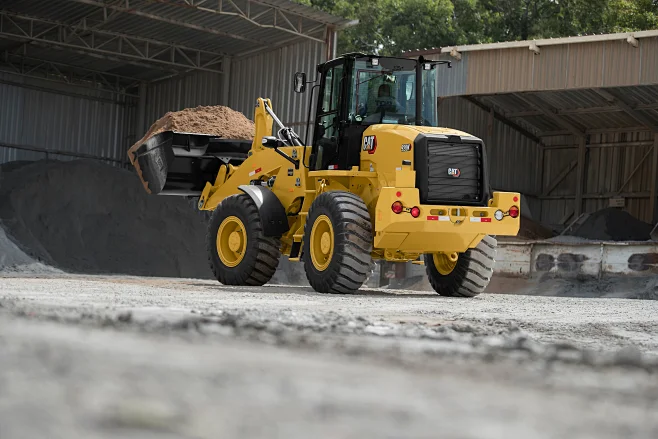
Loading tools at the pit face run L4/L5 treads — extra-deep, cut-resistant patterns that shrug off the rock underfoot. Loader tire selection follows a different logic than haul truck tires because the machine rarely travels far; the entire battle happens within the swing radius of the bucket. Read How to Choose the Right Wheel Loader Tire Size for the machine-by-machine breakdown.
Wheel dozer tires
Dozers used in ripping and dozing overburden need L4/L5 patterns with reinforced sidewalls — dozer tires are the most likely to suffer sidewall cuts from windrows and bench edges. Many mines run dozers on bias tires deliberately for this cut resistance.
The Number Most Buyers Ignore: TKPH
TKPH (Tonne-Kilometre Per Hour) — TMPH in imperial — measures a tire’s heat-handling capacity: how much load-distance work the tire can absorb per hour before internal heat destroys it. It is the single most important spec for haul truck tires, and the one most often skipped in procurement.
Why it matters: a haul truck tire’s #1 killer is heat. Run a tire beyond its TKPH and the casing temperature climbs past the safe threshold; the result is tread separation or a blowout at speed — the most dangerous failure in mining.
The math is simple but the data must be real:
If your cycle analysis says 450 TKPH and the quoted tire is rated 350, you have already lost — regardless of how good the price is. Always ask the supplier to confirm the tire’s TKPH/TMPH rating and match it to your mine’s cycle study, not the brochure’s “typical” numbers.
Radial vs Bias in Mining: It’s Application-Specific
| Factor | Radial (E4) | Bias (E4/E3) |
| Heat generation | Lower — cooler on long hauls | Higher — limited TKPH |
| Footprint | Longer, more even wear | Shorter, more concentrated |
| Cut resistance | Good casing, thinner sidewall | Tougher sidewall, resists sniping |
| Ride on haul roads | Smoother, less machine shock | Harsher |
| Best for | Long haul roads, high speed, distance | Short hauls, severe sidewall-cut risk |
| Cost | Higher initial, lower cost/hour on hauls | Lower initial, higher cost/hour on hauls |
The mining industry’s trend is firmly toward radial for haul trucks — the fuel savings alone (up to 5–8% lower rolling resistance) often pays for the price premium — while bias retains niches where cut risk dominates: dozers, LHDs, and short-travel loaders on sharp floor rock.
What to Look For in a Mining Tire Supplier
Beyond the tire itself, mining procurement should test suppliers on five things:
- TKPH engineering support — will they sit down with your cycle data and confirm ratings, or just quote a price? This single question filters most suppliers.
- Size and load coverage — can they supply the full matrix (2700R49 to 4000R57, plus loader/dozer sizes), or only the easy ones? Split sourcing across suppliers adds logistics risk at the worst possible time.
- Consistent quality and traceability — DOT/ISO traceability, batch documentation, and factory test records. Mines cannot afford a rogue batch in a 400 t truck.
- Lead time and service presence — tire change-out on a haul truck is measured in hours of lost production. Ask about emergency supply, on-site service, and mount/demount support before you sign.
- Cost transparency — ask for cost per hour, retread policy, and warranty terms in writing. A supplier who won’t put numbers on paper is a red flag.
These five map closely to the ten criteria in our How to Choose an OTR Tire Supplier guide — worth reading before your next tender.
Retreading: Where Mining Tire Economics Are Won
A quality mining radial casing costs 60–70% of the tire’s lifetime value. Run it to destruction and you throw that away; protect it and retread it, and two to three retread cycles can cut fleet tire cost per hour by up to a third. This is why tire life management in mining is really casing management:
- Pull tires at the retreadable wear point, never at the cord
- Track TKPH duty per position so no casing is overworked
- Keep TPMS/heat monitoring data to defend retread eligibility
The industry economics of casing management and retreading are covered in depth by Tyrepress, which tracks major mining tire programs and retread policy globally.
Typical Buying Mistakes (and the Fix)
| Mistake | Consequence | Fix |
| Buying on price per tire | 30–50% higher cost/hour | Compare cost per hour over expected life |
| Ignoring TKPH rating | Overheating, blowouts, downtime | Match rating to your cycle study |
| Mixing brands on one axle | Uneven wear, driveline stress | Same brand/model per axle, matched depths |
| Running tires to the cord | Loses retread value | Pull at wear line, schedule rotation |
| No TPMS/heat monitoring | Silent heat damage | Fit TPMS on high-TKPH routes |
| Splitting sizes across suppliers | Stock and logistics chaos | One supplier for the full matrix |
FAQ
What size tires do mining haul trucks use? From 2700R49 on 90–140 t trucks up to 4000R57 and 46/90R57 on 300–400 t ultra-class trucks. The dominant open-pit sizes are 3300R51 (190–240 t class) and 2700R49 (smaller fleets). Match the size to the truck’s OEM rim and load tables — never guess.
Are mining tires radial or bias? Haul truck tires are predominantly radial today because they run cooler, wear more evenly, and save fuel on long hauls. Bias tires survive in cut-dominated roles like dozers, LHDs, and short-travel loaders. “Radial always” and “bias always” are both wrong — it depends on duty cycle.
Why are mining tires so expensive? A 4000R57 mining radial contains roughly 4–5 tonnes of specially compounded rubber and steel, takes hours to build and cure, and must survive loads of 100 t per tire at speed in 40°C heat. The engineering is closer to aerospace than to automotive. That is also why protecting the casing for retreads is so important — the raw material cost is already paid.
What does E4 mean on a mining tire? E is the TRA application code for earthmover; the number is tread depth class. E4 is a rock-tread pattern with extra depth, standard for haul-road and quarry duty. Loader tires use L codes (L3/L4/L5); dozer work often uses L4/L5 patterns too.
How long do mining tires last? Haul truck tires typically deliver 3,500–6,000 hours on well-managed operations, longer on gentle haul roads, far less on severe routes. Loader tires at the face are more variable — see How Long Do Wheel Loader Tires Last for the loader-side numbers. Tire life in mining is a management outcome, not a product specification.
What is the difference between TKPH and TMPH? They measure the same heat-load capacity in different units: TKPH is metric (tonne-km/hour), TMPH is imperial (ton-mile/hour). Convert between them with a fixed factor; the concept is identical — do not exceed the tire’s heat budget over a duty cycle.
Do mining tires need special pressure management? Yes. Inflation must be set per actual load (not per sidewall maximum), and checked on haul trucks frequently — many mines check daily at shift start. TPMS is increasingly standard on ultra-class trucks because it catches slow leaks before they become heat failures.
How do I buy mining tires without getting burned? Follow a process: (1) document your cycle data and TKPH need, (2) tender by cost per hour with retread and service terms included, (3) verify the supplier’s size matrix covers your whole fleet, (4) ask for references from mines with similar duty, (5) put everything — ratings, warranty, service response time — in writing. For a step-by-step checklist, see our OTR tire supplier selection guide. If you are sizing your first mining fleet, talk to our specialists — we will ask about your trucks, ramps, and cycle times before we ever mention a price.
Summary
Mining tires fail for three reasons: wrong size, wrong rating, and wrong management. Getting the buy right is mostly engineering discipline:
- Match size to machine — 2700R49 through 4000R57 for haul trucks, L4/L5 for loaders and dozers
- Match TKPH to your actual cycle — never buy a tire whose heat rating is below your haul profile
- Radial for haul roads, bias where cuts dominate
- Buy cost per hour with service and retread terms, not unit price
- Manage the casing — TPMS, heat monitoring, on-time pulls — because the casing is where the money is
Do these five and mining tires become a predictable line item instead of the fleet’s biggest risk.
Next step: review our rigid dump truck tire range and loader/dozer tire range, or contact our mining tire specialists with your fleet details for a spec-matched recommendation.