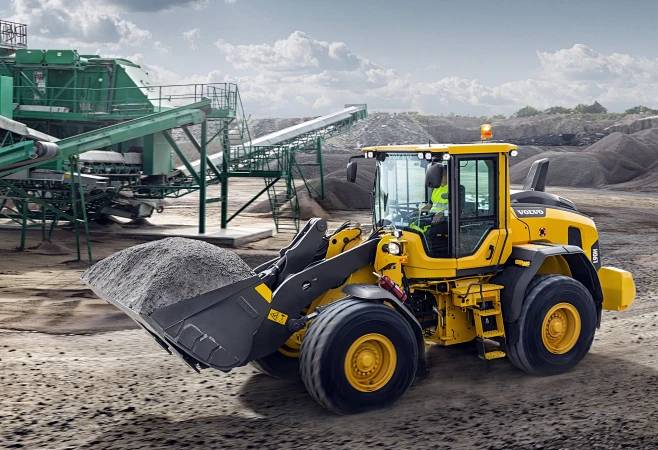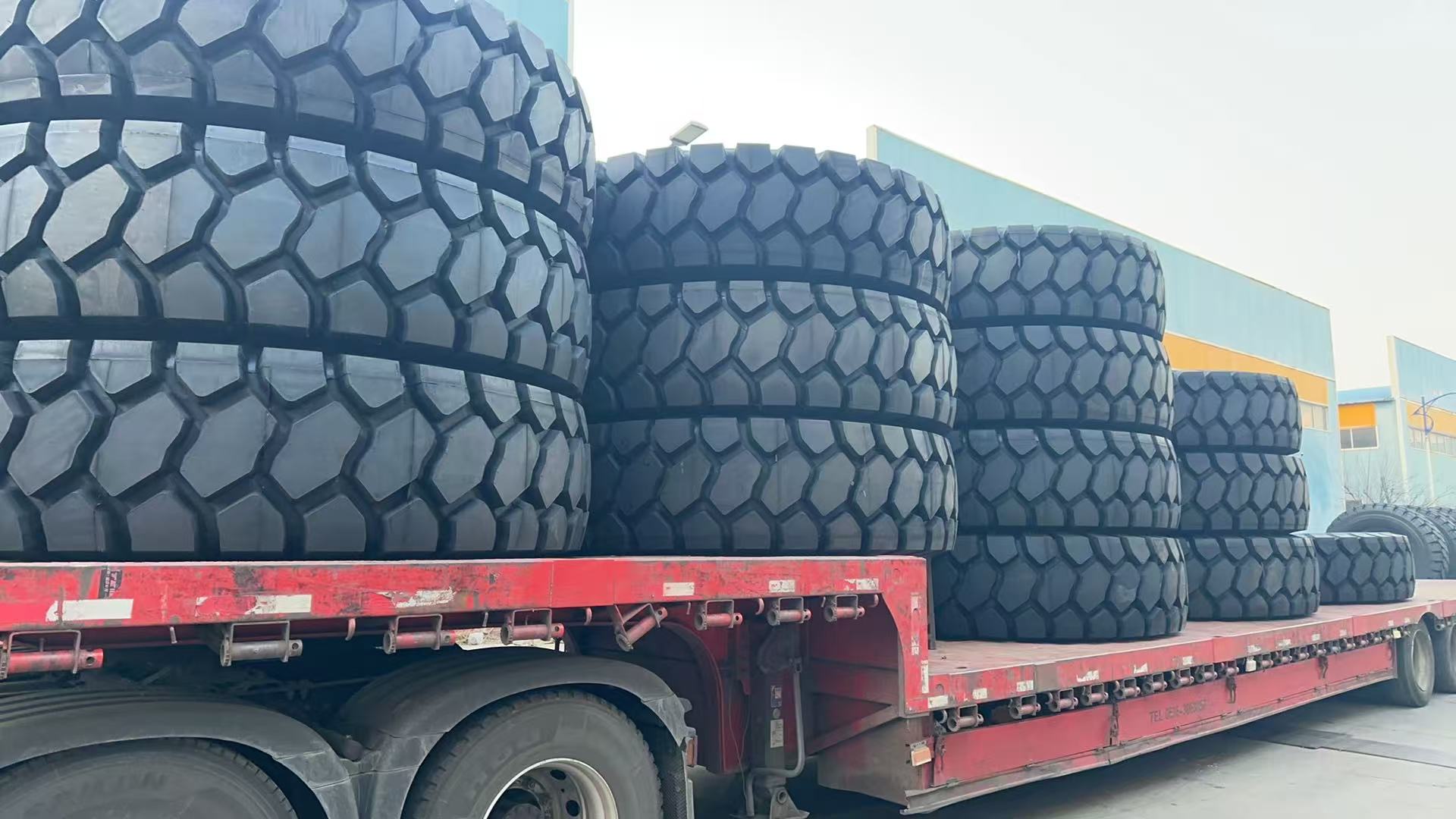
Both of these are big-tire markings. Both fit 25-inch rims. Both show up on wheel loaders working quarries, aggregate yards, and heavy construction sites. And yet the three inches of section width that separate 26.5-25 from 29.5-25 change almost everything that matters in the field: how much load the axle can carry, how hard the tire presses on the ground, whether the loader floats over soft material or digs into it, and how much fuel the machine burns doing it.
This is the third article in our size-comparison series. The first, How to Choose the Right Wheel Loader Tire Size, explains how the sizing system works; the second, 23.5-25 vs 26.5R25, compares two sizes of different construction. This one compares two sizes of the same (bias) construction at different scales — which makes it a cleaner question: is bigger better, and what does bigger actually cost?
Reading the Two Markings First
| Marking | Reads as | Construction |
26.5-25 |
26.5 in nominal section width, 25 in rim diameter | Bias (cross-ply) |
29.5-25 |
29.5 in nominal section width, 25 in rim diameter | Bias (cross-ply) |
Neither marking contains an “R”, so both are bias tires — the architecture explained in What Is a Radial OTR Tire?. Radial equivalents of both sizes exist (26.5R25 is common; 29.5R25 appears on some heavy loaders), and the radial-vs-bias decision can be made independently of the size decision. This article is about the size.
A note on the numbers below: dimensions and load figures are industry-typical values for orientation. Always verify against the sidewall markings, the tire manufacturer’s data book, and your machine manual before ordering — TRA and ETRTO publish the standardized tables your supplier should be quoting from.
The Headline Differences
| Dimension | 26.5-25 | 29.5-25 | What it means on site |
| Nominal section width | 26.5 in (~673 mm) | 29.5 in (~750 mm) | ~11% wider contact patch |
| Typical overall diameter | ~1.75 m class | ~1.92 m class | Higher axle clearance, higher machine height |
| Single-tire load capacity (typical, at rated pressure) | ~15–16 t class | ~20 t class and above | 29.5-25 carries materially more load per tire |
| Typical inflation | High-pressure service (per data book) | High-pressure service (per data book) | Both are stiff-casing bias tires |
| Ground pressure | Higher | Lower (bigger footprint) | 29.5-25 floats better on soft ground |
| Rolling resistance / fuel draw | Lower | Higher (more tire, more weight, more flex) | Bigger tires cost fuel every hour |
| Typical machine class | 3–5 m³ bucket loaders (Cat 972/980, Komatsu WA500, Volvo L120–L150 class) | 5–6 m³ heavy loaders (larger domestic and international heavy-class machines) | Match the machine, never guess |
| Tire + rim weight per position | Lower | Higher | Handling, mounting equipment, and shipping cost all scale up |
| Price per tire | Lower | Higher (roughly in proportion to mass) | Total set cost jumps noticeably |
The pattern to notice: the 29.5-25 is not a “better 26.5-25” — it is a bigger tire with a bigger appetite. It carries more, floats better, and clears obstacles more easily. It also weighs more, burns more fuel, costs more to buy and to ship, and demands more from the machine’s axle, hydraulics, and fenders.
Where 26.5-25 Wins
1. Hard-surface and stockpile duty. On processed aggregate, hardstand, and completed grades, flotation is irrelevant — the ground supports the machine anyway. The 26.5-25’s lower rolling resistance and weight translate directly into fuel savings and quicker cycle times.
2. Cost per hour on mixed fleets. For loaders that split time between the yard and light tramming, the smaller tire’s purchase price, mounting costs, and fuel draw usually produce the better cost-per-hour outcome. The cost-model structure for this math is laid out in our loader tire lifespan guide.
3. Availability. 26.5-25 is one of the highest-volume OTR sizes in the world. Pattern and brand choices are broad, and stock is usually deep — which matters when a damaged tire needs replacing this week, not next quarter. Availability details for this size are in our 23.5-25 spec guide’s size family and in the loader tire lineup.
4. Machine margins. The machine was engineered around its factory size. Fitting the size the manufacturer specified keeps axle loads, stability, braking, and speed ratings inside their design envelopes.
Where 29.5-25 Wins
1. Soft and yielding ground. This is the decisive advantage. A wider, taller tire spreads the same machine weight over a larger footprint, reducing ground pressure. On sand, mud, reclaimed material, and loose overburden, a 29.5-25 loader keeps working after a 26.5-25 machine starts digging itself in.
2. Heavier buckets and attachments. If the loader runs a heavier-than-standard bucket, ripper, or material handling arm, the higher single-tire load capacity of the 29.5-25 gives the axle real headroom — provided the machine is specified or approved for it.
3. Rock and debris clearance. The taller section rides over rock, stumps, and spillage that a smaller tire climbs over or cuts against — more clearance under the axle and less sidewall contact with the pile.
4. Traction in loose material. The bigger lug and footprint area gives more bite when loading from loose stockpiles, which cuts wheel-spin — one of the fastest tire-killers in any application, as covered in our quarry tire guide.
Can You Upsize from 26.5-25 to 29.5-25?
This is the question the article exists for, because it gets asked constantly — usually by an owner who has seen another machine “upgraded” and wants the flotation.
The honest answer: it depends on the machine, and the machine’s manufacturer — not the tire seller — is the authority.
What has to be checked before any upsize:
- Rim compatibility. The two sizes do not share rim widths. An upsize means new rims, not just new tires — a significant cost that is often overlooked at quotation stage.
- Fender and frame clearance. Three inches of section width plus a taller section has to fit through the full suspension and steering arc, loaded and unloaded.
- Axle and final drive ratings. Bigger tires increase the lever arm on axle components and can change effective gearing. Some machines are approved for both sizes; many are not.
- Load and speed ratings. The machine’s rated payload and travel speed must sit inside the new tire’s envelope at the specified pressure.
- Total height and stability. Taller tires raise the center of gravity and change the stability the machine was certified with.
Where the manufacturer explicitly approves the larger size (some heavy loader models are offered in both), an upsize can be a rational soft-ground upgrade. Where it does not, the tire will physically mount but the machine’s warranty, stability, and driveline will not follow it.
Decision Table by Working Condition
| Your situation | Recommended size | Reasoning |
| Processed aggregate, hardstand, mostly stockpile work | 26.5-25 | Fuel and cost per hour dominate |
| Quarry face on blasted rock, standard machine | 26.5-25 (or per OEM options) | Match the machine; pattern and depth matter more than width |
| Sand, mud, soft reclaimed ground | 29.5-25 (if machine-approved) | Ground pressure and flotation decide whether the machine works at all |
| Heavier aftermarket bucket / attachments | 29.5-25 (verify axle ratings) | Load headroom per position |
| Long tramming cycles on firm surfaces | 26.5-25 | Rolling resistance is a real fuel line item |
| Replacing a mixed, aging set on a budget | 26.5-25 | Availability, price, and one-size simplicity |
| Haul road loading with high spin rates | 29.5-25 where approved | Bigger footprint, less spin, less heat |
One rule overrides the whole table: never mix sizes across an axle or between axles. Different diameters on the same machine create permanent driveline wind-up and unequal load sharing. Replace in complete sets per axle, or at minimum in matched pairs across an axle.
Cost Reality Check
Comparing the two sizes honestly means comparing them per hour, not per tire. Indicative logic — actual numbers vary by brand and market, and tire pricing moves with rubber and freight indices that Tyrepress tracks continuously:
- Purchase price: the 29.5-25 set costs more per position, plus new rims if upsizing.
- Fuel: more tire mass and flexing area costs fuel every operating hour — the larger size runs a real ongoing premium.
- Wear life: in similar conditions the larger tire can last longer simply because the footprint work is spread over more rubber, but on abrasive hard surfaces the fuel and price premium usually outweigh the wear gain.
- Downtime: 26.5-25’s better stock availability often decides total cost in practice — a loader waiting two extra weeks for a tire is the most expensive line on the page.
The 29.5-25 earns its premium when flotation or load capacity unlocks work the machine could not otherwise do. If it is not unlocking work, it is only adding cost.
Frequently Asked Questions
What is the difference between 26.5-25 and 29.5-25 tires?
Three inches of nominal section width and a taller section — which together mean a bigger footprint, lower ground pressure, higher load capacity per tire, greater machine height, more weight, and a higher price. Both fit 25-inch rims, but they require different rim widths.
Will a 29.5-25 tire fit my loader?
Only if your machine is specified or approved for it by its manufacturer. Physically, the sizes need different rims and fender clearance; mechanically, bigger tires change axle loads, gearing, and stability. Check the machine manual or ask the OEM — do not rely on a tire seller’s assurance.
Which tire is better in mud and soft ground?
The 29.5-25, clearly. Its larger contact area lowers ground pressure, so the machine floats on material that would bog a 26.5-25 machine. This is the single biggest practical reason to upsize.
Which tire lasts longer?
On similar duty, the larger tire spreads wear over more rubber and can deliver longer tread life. But on hard surfaces its higher price and fuel draw usually mean the 26.5-25 wins on cost per hour. Match the size to your ground first, then optimize cost.
Can I put 26.5R25 radial tires on rims I bought for 29.5-25?
No — sizes and constructions cannot be mixed this way. Each tire size has a specified rim width range, and radial and bias tires have different rim requirements. Fitting mismatched combinations is a safety issue and voids warranties.
Why is 26.5-25 cheaper and easier to find?
It is one of the world’s highest-volume OTR sizes, fitted across an enormous population of mid-weight loaders. Volume means more manufacturers, more patterns, deeper stock, and lower unit cost.
Do bigger tires affect fuel consumption?
Yes. Larger tires add rotating mass and flexing rubber, which raises rolling resistance. The difference is a real percentage of fuel burn, paid every hour the machine runs — which is why upsizing for looks rather than ground conditions is an expensive habit.
What tread pattern should I pair with either size?
Choose by surface and cut risk — L3/L4 rock-service patterns for quarry and blasted rock, standard traction patterns for stockpile and softer material. Pattern depth guidance is in our quarry tire guide, and pattern availability by size is shown in the loader tire range.
Summary: Choosing Between 26.5-25 and 29.5-25
- Same construction, different scale. This is a size decision, not a construction decision — and it is governed by your ground, not by preference.
- 26.5-25 wins on hard surfaces, mixed duty, fuel, price, and availability.
- 29.5-25 wins on soft ground, flotation, heavier attachments, and debris clearance — where it unlocks work the smaller tire cannot do.
- Upsizing is an OEM question. Rims, clearance, axle ratings, and stability all have to be approved before a 26.5-25 machine moves to 29.5-25.
- Compare cost per hour, per machine, not per tire. Fuel, rims, and downtime belong in the comparison.
- Never mix sizes on one machine. Sets per axle, matched pairs minimum.
Not sure which size your machines actually take? Send us your machine models and site conditions — we will confirm the correct size, pattern, depth, and current stock position, or browse the OTR range for specifications.