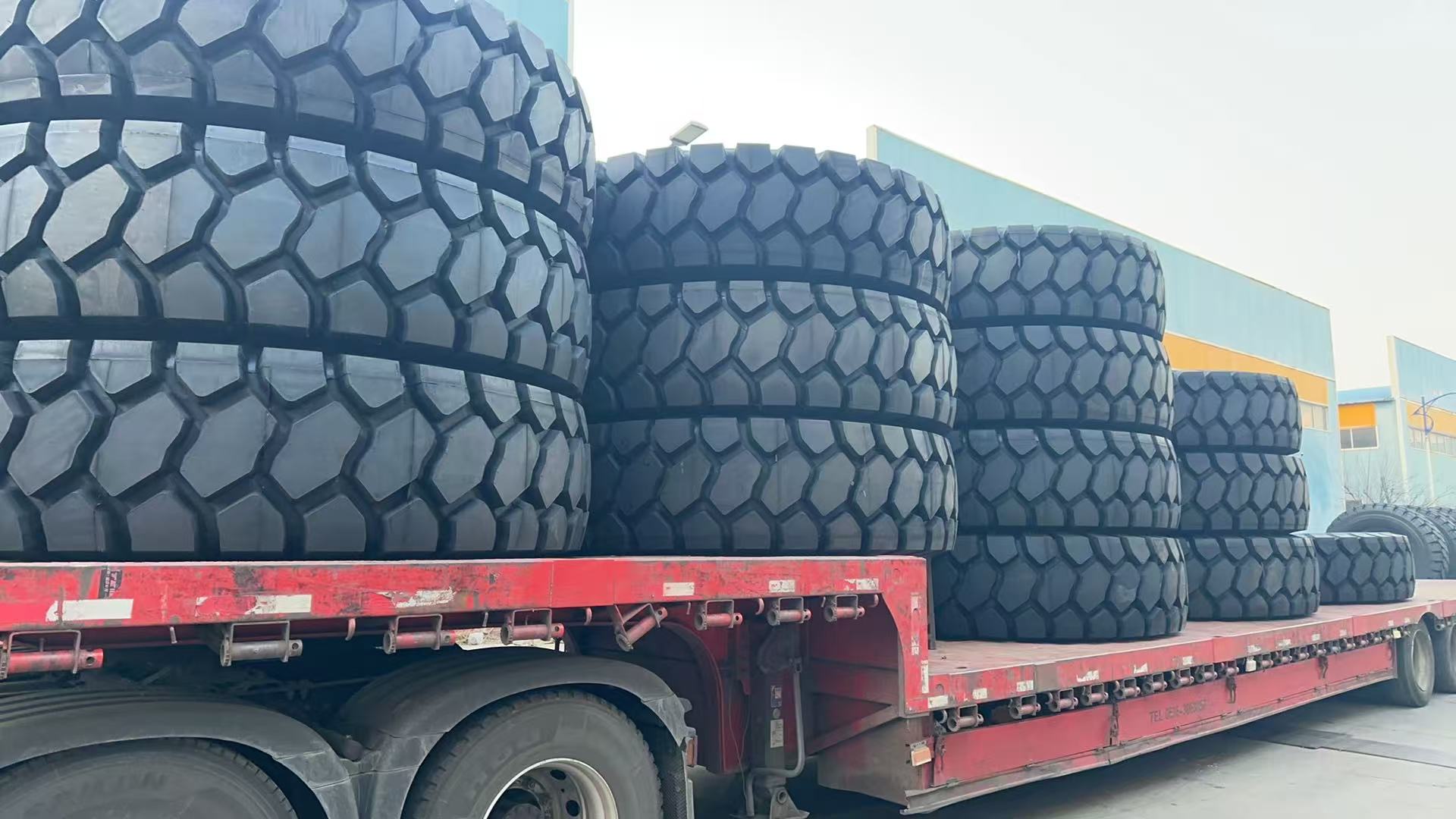
An OTR tire can spend a year in a corner of your yard before it ever touches a machine — and emerge worth considerably less than the day it arrived. Not because anything dramatic happened, but because tires age silently. Ozone cracks the rubber, ultraviolet light bakes it, heat accelerates the chemistry, and a stack stored the wrong way slowly deforms its own bottom layer into an oval.
Tire storage is one of those topics that looks trivial until you price the damage. A yard holding a full spare set of 23.5-25 loader tires is holding a five-figure asset that can be degraded by nothing more than where it was stacked and what was running next door. This guide covers the environment rules, the stacking methods, the shelf-life question every buyer eventually asks, and a checklist you can walk your own storage area against this week.
Why Storage Actually Matters
Tires are a engineered composite of rubber compounds, steel, and textile — the construction is explained in our OTR tire overview — and that composite ages whether or not it is mounted. The difference between a well-stored and badly-stored tire is not visible on day one. It shows up as:
- Reduced casing life in service — a tire stored badly for two years may run, but it will not deliver the hours a fresh casing would
- Retread rejection — cracked or weathered casings get turned away by retreaders, destroying the second and third life that makes OTR tire economics work
- Warranty complications — damage from improper storage is generally excluded from manufacturer warranties
- Scrapped spares — in the worst cases, an expensive spare becomes unusable before it is ever fitted
For fleets buying ahead because of lead times — the norm in OTR procurement — storage quality is effectively part of the purchase price.
The Five Enemies of a Stored Tire
| Enemy | What it does | Where it hides |
| Ozone | Attacks rubber molecules, causing fine surface cracks that grow into the sidewall | Electric motors, welders, generators, transformer rooms — anywhere there is arcing or heavy electrical switching |
| UV light | Degrades the rubber surface (dry, chalky, cracked exterior) | Outdoor yards, windows in storage buildings |
| Heat | Accelerates every aging reaction; softens compounds | Direct sun, radiators, south-facing walls, containers |
| Deformation | Sets a permanent flat spot or oval shape; stresses carcass structure | Tall horizontal stacks, tires resting on edges or protruding objects |
| Moisture & chemicals | Attacks rubber and steel cords; promotes corrosion in exposed bead wires | Wet floors, standing water, fuel/oil/solvent storage nearby |
Two of these — ozone and UV — are invisible in the early stages. A yard can be quietly cracking a tire inventory for months before anyone notices the crazed sidewall surfaces.
Environment Rules: Where to Put Them
The storage environment does not need to be sophisticated. It needs to be cool, dark, dry, ventilated, and electrically quiet:
- Temperature: ideally below 25 °C and never above 35 °C for extended periods. Every sustained 10 °C above normal roughly doubles the rate of rubber aging chemistry.
- Light: no direct sunlight. If tires must be outdoors temporarily, cover them with an opaque, breathable tarp — not clear plastic, which traps heat.
- Humidity: dry, ventilated space. Trapped condensation under tarps or plastic wrap does more harm than open-air exposure.
- Away from ozone sources: keep tires well clear of electric motors, welding bays, generators, and switchgear rooms. This is the single most commonly violated rule in machine shops — the welding corner and the tire rack share a wall in more yards than anyone admits.
- Away from chemicals: no fuel, oils, solvents, acids, or degreasers stored in the same area. Rubber compounds swell and weaken on contact with hydrocarbons.
- Off the ground: rack, pallet, or timber — never directly on concrete that sweats or on soil that stays damp.
Manufacturers’ storage guidance aligns with the same service-condition standards context published by TRA and ETRTO: tires are engineered for defined conditions, and shelf life assumptions only hold if those conditions are respected.
How to Stack: Vertical vs Horizontal
This is where most storage damage happens, and the rules differ by tire type and duration.
Unmounted tires — short term (up to ~4–6 weeks)
- Store upright (on tread, as the tire stands on a machine), ideally on a clean, dry surface
- Rotate a quarter turn every few weeks so the load point keeps changing and the casing does not take a set
Unmounted tires — long term
- Horizontal stacking is acceptable but limited: stack height typically no more than 2 meters; heavier/giant OTR sizes lower still — a 3300R51 does not belong in a tall stack under any schedule
- Larger tires on the bottom of any mixed stack
- Check the stack periodically — the bottom tires carry the weight of everything above them, and compression set is cumulative
Mounted tires (on rims)
- Store inflated at operating pressure, upright or in racks designed for mounted assemblies
- Never store mounted tires flat (horizontal) for long periods — the sidewalls bulge under the static load and can develop permanent deformation, especially at high inflation
- Keep valves capped and check pressure monthly; slow leaks turn a mounted spare into a flat-spotted spare
Quick stacking reference
| Tire state | Best method | Limit / note |
| Unmounted, short term | Vertical (on tread) | Rotate a quarter turn every few weeks |
| Unmounted, long term | Horizontal stack | ≤ ~2 m tall; heaviest at bottom; inspect periodically |
| Mounted, on rim | Upright, inflated at service pressure | Never flat long-term; monthly pressure check |
| Giant sizes (33″/51″/57″ rim class) | Vertical or single-layer | Never build tall stacks; use dedicated racks |
| Foam-filled / solid assemblies | Racked per supplier guidance | Weight per unit is extreme — verify rack loading |
How Long Can You Store an OTR Tire?
There is no single expiry date stamped on an OTR tire, but there are well-established rules of thumb:
- Tires are not milk; they do not spoil on a date. Age matters, but condition matters more. A tire stored cool, dark, and correctly stacked for five years can be in better shape than one cooked behind a generator shed for eighteen months.
- The practical guidance used across the industry: with proper storage, tires are generally fit for many years of shelf time, and each tire should pass a professional inspection before fitting — especially checking for ozone cracking, bead damage, and deformation.
- Read the DOT or production week code on the sidewall to know what you actually have. A “new” tire bought at a discount is sometimes years older than the machine it is being fitted to.
- First in, first out (FIFO): rotate your stock so the oldest sound tires get fitted first. A spare that sits for a decade while newer tires get used around it is inventory mismanagement, not prudence.
The same aging factors that damage stored tires also operate — much faster — in service; our article on why OTR tires fail covers how age-related cracking and dry rot fit into the wider failure picture. And remember that shelf age consumes some of the service life budget: a tire’s total useful life is shared between the rack and the machine, which is one more reason the cost-per-hour math in our loader tire lifespan guide rewards buying for near-term needs rather than deep speculative stock.
A 10-Point Storage Checklist
Walk your storage area against this list:
- Storage area below ~25 °C, with no sustained heat sources nearby
- No direct sunlight on any tire (indoors or covered)
- No electric motors, welders, or switchgear in or adjacent to the tire area
- No fuels, oils, solvents, or chemicals stored in the same space
- Tires off the ground on racks, pallets, or clean timber
- Stacks within height limits, heaviest tires at the bottom
- Vertical tires rotated quarterly; horizontal stacks inspected periodically
- Mounted tires upright, inflated to service pressure, valves capped, checked monthly
- Stock organized FIFO — oldest sound stock fitted first
- Every tire inspected (cracking, beads, deformation) before mounting
Nine out of ten items on that list cost nothing but attention. The storage investment that pays for itself fastest is the rack that keeps tires off a damp floor.
Frequently Asked Questions
How should OTR tires be stored — vertically or horizontally?
For short-term storage, upright (on the tread) with a periodic quarter-turn rotation. For longer storage, limited horizontal stacks are acceptable — typically under about two meters, heaviest tires at the bottom, with periodic inspection. Mounted tires should always be stored upright at service pressure, never laid flat for long periods.
How long can tires be stored before they go bad?
There is no fixed expiry date. Under proper conditions — cool, dark, dry, away from ozone — tires remain serviceable for years, but every tire should be professionally inspected before fitting, regardless of age. Poor storage can ruin a tire in months, while good storage preserves it far longer than most buyers expect.
Can I store tires outside?
Not recommended except briefly. UV light and heat degrade rubber continuously, and covered outdoor storage trades UV for trapped moisture. If outdoor storage is unavoidable, use an opaque, breathable cover, keep tires off the ground, and move stock through quickly.
Why are electric motors and welding equipment bad for tires?
They generate ozone. Ozone attacks rubber at the molecular level, producing fine surface cracks — usually first visible on the sidewall — that deepen over time and can eventually reject the casing from retreading. It is one of the most common and least suspected causes of tire storage damage.
Do stored tires need to be inflated?
Only mounted (on-rim) tires, which should be kept at service pressure with valves capped. Unmounted tires are stored without significant inflation pressure and rely on correct stacking and rotation to avoid deformation.
Does tire age matter if the tire has never been used?
Yes, though less than condition. Rubber compounds age through oxidation and ozone attack whether or not the tire rolls. Check the sidewall date code, inspect before fitting, and prioritize older sound stock first. Deep-stacking tires “for a rainy day” spends shelf life that the tire will never get back.
Can a stored tire be retreaded later?
Often, yes — if the casing was stored properly. Cracked, weathered, or deformed casings are rejected at retread inspection. Since retreading is where much of an OTR tire’s lifetime value comes from — an economics story followed closely by USTMA — protecting casings in storage protects your retread asset.
What is the best way to store giant OTR tires?
Vertically in dedicated racks or single-layer positioning. Giant tires (33-inch and larger rim sizes) should never be built into tall stacks: the weight of the upper tires permanently deforms the bottom casings, and handling them safely requires equipment rated for their extreme unit weight.
Summary: Store Them Like the Asset They Are
- Five enemies: ozone, UV, heat, deformation, moisture/chemicals — and the first two are invisible until the damage is done.
- The environment is simple: cool, dark, dry, ventilated, away from electrical equipment and chemicals.
- Stacking has rules: vertical with rotation for short term; limited horizontal stacks for long term; mounted tires upright at service pressure.
- There is no expiry date, but there is an inspection gate — check age code, cracking, beads, and shape before fitting anything.
- Run FIFO so stock ages on machines, not on racks.
- Storage is part of purchase economics: a protected casing keeps its retread value; a degraded one is scrap.
If you are planning a spare-tire program and want sizes, stock positions, and rotation guidance matched to your fleet, send us your machine list — or browse the OTR range to see what is available for scheduled delivery rather than long-term storage.