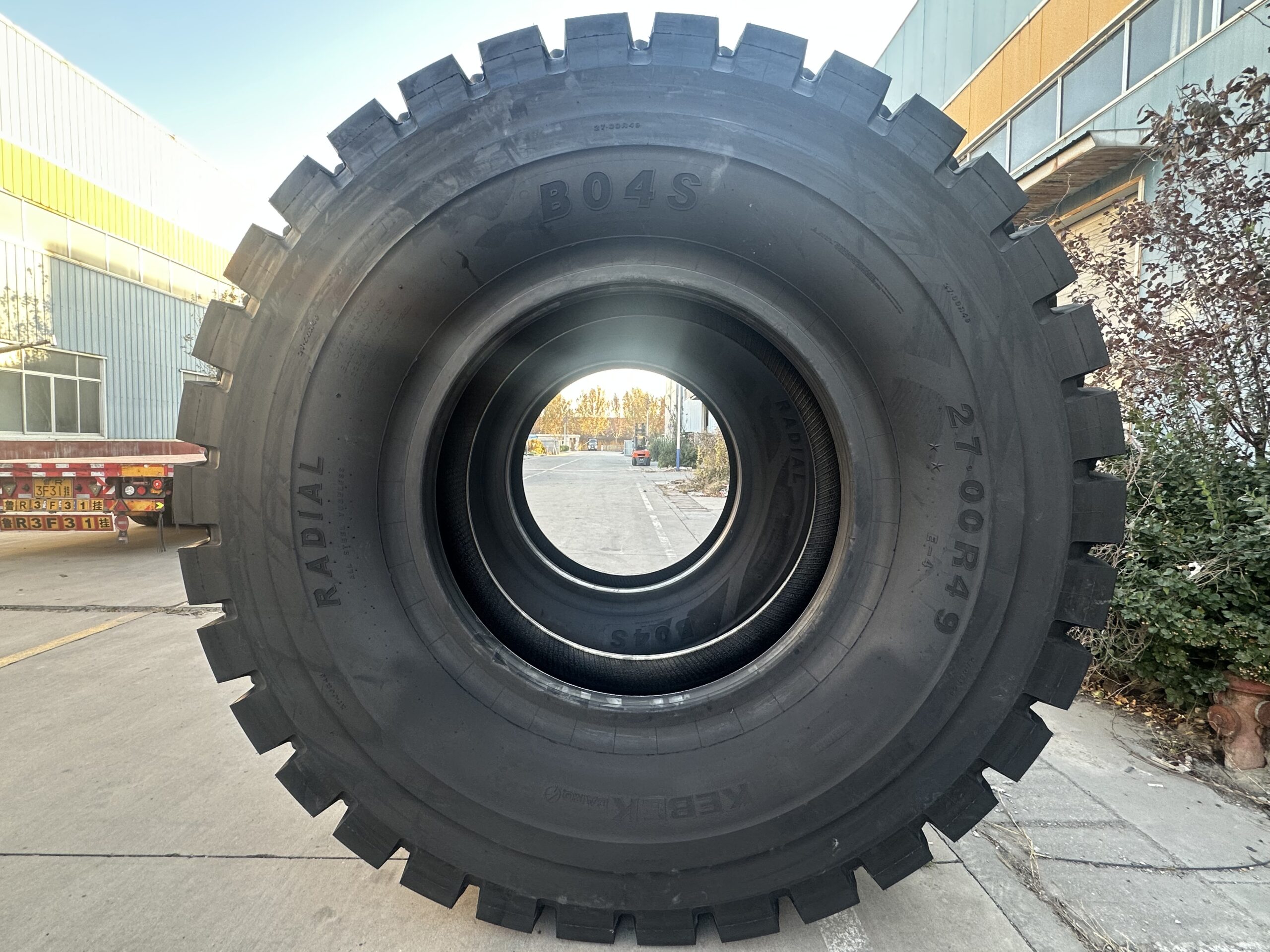
Look at the sidewall of a loader tire and you will see one of two things: 26.5R25 or 26.5-25. That single letter — the R — is the most consequential character on the tire. It tells you which of two completely different internal architectures you are buying, and it explains most of the difference in price, wear life, fuel consumption, and repairability between two tires that look identical from the outside.
This article is about that letter and what sits behind it. We will open up a radial OTR tire layer by layer, explain why the construction produces the performance it does, and be equally clear about where radial tires are the wrong choice.
If you want the broader picture of off-the-road tires first, start with What Is an OTR Tire?.
The Short Answer
A radial OTR tire is an off-the-road tire whose carcass body plies run radially — at roughly 90 degrees to the centerline of the tread — and which is stabilized by a rigid, largely inextensible belt package beneath the tread.
A bias (cross-ply) OTR tire instead uses body plies laid at roughly 30–40 degrees that cross each other diagonally. In a bias tire, the plies do the work of both carrying load and stabilizing the tread.
That single architectural difference — separating the load-carrying function from the tread-stabilizing function — cascades into almost every performance characteristic that matters in the field.
Inside a Radial OTR Tire: How It Is Built
A radial OTR tire is not one material. It is a composite assembly of rubber compounds, steel cord, and textile, each engineered for a different job. Here is what sits inside, from the outside in:
| Component | Material | What it does | What happens if it is wrong |
| Tread | Cut- and heat-resistant rubber compound | Provides traction and wears away as the service surface | Fast wear, chunking, heat build-up |
| Undertread | Softer cushion compound | Bonds tread to belts, absorbs impact | Tread separation, belt exposure |
| Belt package (breakers) | Multiple steel cord plies at low angle | Stabilizes the tread, resists penetration and cuts | Penetration damage, irregular wear |
| Carcass body plies | Steel (heavy OTR) or textile cord at ~90° | Carries the load, holds inflation pressure | Casing failure, ply separation |
| Bead bundle | High-tensile steel wire rings | Locks the tire to the rim | Rim slip, bead damage |
| Chafer / bead filler | Abrasion-resistant compound | Protects the bead area against rim chafing | Bead chafing, air loss |
| Inner liner | Low-permeability compound | Retains air in tubeless designs | Slow pressure loss → heat → casing death |
| Sidewall | Flex-resistant, ozone-protected compound | Protects the carcass from weather and abrasion | Cracking, sidewall cuts |
The key point: in a radial tire the belt package does the stabilizing and the carcass does the load carrying. In a bias tire, one structure does both — which is why bias construction demands more plies, more rubber, and generates more internal friction.
Why the Construction Produces the Benefits
Three mechanisms explain nearly all radial performance advantages.
Mechanism 1: The sidewall flexes independently of the tread
With carcass cords running radially, the sidewall can deflect under load while the tread footprint stays relatively stable. The tire absorbs bumps through the sidewall instead of transmitting them through the tread. This is why radial OTR tires run cooler, protect machine components, and give operators a more stable platform on uneven ground.
Mechanism 2: The rigid belt keeps the footprint flat
The steel belt package resists deformation, so the tire maintains a flatter, more uniform contact patch instead of the “bulged” footprint typical of bias tires. A flatter footprint means less scrubbing and slip between tread and ground — the primary driver of dramatically longer tread life.
Mechanism 3: Less internal friction means less heat
Bias tires generate heat through inter-ply friction each time the tire rolls through its deflection cycle. Radial tires have fewer moving interfaces, so they generate less heat at the same load and speed. Lower heat is what allows a radial tire to carry heavier loads at higher speeds — the basis of TKPH ratings in haul truck service.
Standardized load and inflation baselines from TRA and ETRTO are built around these different behaviors: a radial and a bias tire of the same nominal size usually do not share the same load rating at the same pressure.
Radial vs Bias OTR Tires: What Changes in the Field
| Dimension | Radial OTR tire | Bias OTR tire |
| Carcass cord angle | ~90° (radial) | ~30–40° (crossed) |
| Tread stabilization | Steel belt package | Body plies |
| Sidewall stiffness | Flexible | Stiff |
| Tread wear life | Typically 30–50% longer in comparable service | Baseline |
| Heat generation | Lower | Higher |
| Rolling resistance / fuel use | Lower (meaningful fuel savings on load-and-carry work) | Higher |
| Cut & penetration resistance | Better in the tread; weaker in the sidewall | More forgiving sidewall |
| Ride and operator comfort | Noticeably better | Harsher |
| Casing retread potential | Higher (often 2–3 retreads) | Lower |
| Purchase price | Higher | Lower |
| Sensitivity to wrong inflation | Higher — damage accumulates faster | More tolerant |
| Best suited to | High-hour load-and-carry, hauling, hard surfaces | Severe cut risk, short cycles, low-speed impact work |
For a like-for-like size comparison on a specific machine, see our breakdown of 23.5-25 vs 26.5R25 loader tires.
The Eight Practical Benefits
1. Longer tread life. The flat, stable footprint reduces scrubbing, which is the dominant wear mechanism on hard surfaces. Field experience across load-and-carry operations commonly shows 30–50% more tread life than bias in the same application.
2. Lower cost per hour — not lower price. The acquisition price is higher, but service life and retread potential usually make the cost per operating hour lower on high-hour machines.
3. Better fuel economy. Lower rolling resistance matters most on load-and-carry cycles where the machine travels loaded for long distances. Savings are typically in the mid-single digits as a percentage of fuel use, which is significant in a fleet running thousands of hours a year.
4. Higher heat capacity. The lower internal heat generation raises the tire’s TKPH ceiling — the practical limit on how fast and how far a haul truck tire can work before heat destroys the casing. This is why large mining haul trucks run radial almost exclusively.
5. Better load efficiency. For a given size, radial construction generally supports more load at the same pressure, or the same load at lower pressure.
6. More retread lives. A cooler-running, more robust casing can be retreaded more times. The retreading economics that Tyrepress covers continuously are a direct function of casing quality — radial casings are the more valuable asset.
7. Better operator comfort and machine stability. Sidewall compliance absorbs shock that would otherwise reach the axle, the boom, and the operator. On wheel loaders this translates into faster cycle times and less operator fatigue over a shift.
8. Less damage to the machine. Reduced shock transmission protects rims, bearings, and structural components — a benefit that never appears in a tire quotation but does appear in maintenance budgets.
Where Radial Tires Have Real Limits
A supplier who tells you radial is always better is selling, not advising. Four genuine limitations:
1. Sidewalls are more vulnerable to cuts. The flexible, thinner sidewall that gives a radial its ride advantage is also easier to slice on sharp rock faces, demolition debris, and broken concrete. In operations where sidewall cutting dominates, a bias tire or a radial with a reinforced sidewall can outlast a standard radial.
2. Higher initial outlay. A radial tire can cost materially more up front. On low-hour machines or short-cycle work, the payback period may never arrive — the cost-per-hour advantage needs enough hours to accumulate.
3. Less forgiving of wrong inflation. Because a radial sidewall flexes more, running it underinflated does damage faster than with a bias tire. Pressure discipline is not optional.
4. Tougher field repair and stricter rim requirements. Radial casings demand proper repair procedures and compatible rims and valves. Improvised repairs that “work” on bias tires can write off a radial casing.
How to Identify a Radial Tire on the Sidewall
| Sidewall marking | Meaning | Example |
26.5R25 |
Radial construction, 26.5 in section width, 25 in rim diameter | Radial loader tire |
26.5-25 |
Bias construction, same nominal size | Bias loader tire |
3300R51 |
Radial haul truck tire (R = radial, 51 in rim) | Mining haul tire |
18.00-33 |
Bias haul/loader tire | Older or short-cycle machines |
E-3 / L-3 / L-5 |
Tread depth and application code (standardized) | Deeper code = more cut protection |
Note the trap: a 26.5R25 and a 26.5-25 are not interchangeable. Beyond the construction difference, the required rim and the load ratings differ — mounting a radial on a rim specified for bias (or the reverse) is a safety and warranty issue, not a preference.
Matching Construction to Application
| Application | Recommended construction | Reasoning |
| Mining haul trucks (rigid dump trucks) | Radial, E4 | TKPH heat ceiling and long-haul fuel savings dominate |
| Wheel loaders on load-and-carry duty | Radial | Travel distance justifies wear and fuel advantage |
| Wheel loaders in tight, rocky faces | Bias or reinforced-sidewall radial | Sidewall cut risk outranks tread life |
| Dozers and ripping work | Bias (commonly) | Sidewall protection and impact tolerance; radial used in high-hour mine dozing |
| Graders | Radial | Precision, uniformity, and surface finish |
| Forklifts and port handlers | Solid, pneumatic, or foam-filled per duty | Low speed and tight turns make solid options competitive |
| Aerial work platforms | Non-marking pneumatic, foam-filled, or solid | Stability and puncture immunity matter more than tread life |
For haul truck and mining-specific selection logic, including TKPH calculations, see the mining tire buyer’s guide.
Four Common Misconceptions
“Radial is always the better tire.” Only if the machine accumulates enough hours and the sidewall is not the failure mode. In severe cut environments, bias still wins.
“I can mix radial and bias on the same axle.” Never. Different deflection characteristics on the same axle create load imbalance, uneven braking, and accelerated failure.
“Radial tires last longer, so I can run them at lower pressure to soften the ride.” Underinflation is the fastest way to destroy a radial casing. The construction that makes radial efficient also makes it less tolerant of pressure error.
“A retreaded radial is a compromise.” A properly retreaded radial casing is standard practice in mining and quarrying — provided the casing was pulled before bead or belt damage occurred.
Frequently Asked Questions
What does the “R” in 26.5R25 mean?
It designates radial construction. In 26.5R25, 26.5 is the nominal section width in inches, R means radial, and 25 is the rim diameter in inches. A 26.5-25 marking indicates bias construction at the same nominal size.
Are radial OTR tires better than bias?
They are better where travel distance, load, and speed are high, and worse where sidewall cutting is the dominant failure mode. Radial tires deliver longer tread life, lower fuel consumption, and higher heat capacity; bias tires are cheaper, more cut-tolerant in the sidewall, and more forgiving of pressure error.
How much longer do radial OTR tires last?
In comparable load-and-carry service, radial tread life typically runs 30–50% longer than bias. Actual results depend heavily on surface, load, inflation discipline, and operating practice — the same factors our loader tire lifespan guide breaks down by application.
Can I mount a radial tire on a rim designed for bias tires?
No. Radial and bias tires require different rims, and the load ratings differ even at identical nominal size. Always confirm the rim specification before ordering.
Why do mining haul trucks almost always use radial tires?
Because heat, not tread wear, limits haul truck tires. Radial construction generates less internal heat, which raises the tire’s TKPH ceiling — the amount of work it can do per hour without overheating.
Do radial tires really save fuel?
Yes, through lower rolling resistance. The saving is most visible on cycles with long loaded travel. It is a percentage of fuel cost, not a fixed number, so the value scales with fleet hours.
Are radial OTR tires harder to repair?
They require correct procedures, proper patch materials, and a sound casing. Improvised repairs acceptable on bias casings can render a radial casing unusable — which is one more reason to treat casing inspection as a routine, not an emergency task.
Which is better for a dozer?
Most dozers still run bias tires because sidewall protection and impact tolerance matter more than tread life in pushing and ripping work. Radial tires are used in high-hour mine dozing where travel distance justifies the investment.
Summary: Radial OTR Tire Construction in Practice
- The architecture is the difference. Radial carcass plies at ~90° carry the load; a steel belt package stabilizes the tread. Bias plies do both jobs.
- Separating those functions produces the benefits — longer tread life, lower heat, lower fuel use, more retreads, better ride.
- The benefits are payback-dependent. Radial wins where machines accumulate high hours and travel distances; it needs those hours to earn its price premium.
- The sidewall is the trade-off. Flexible sidewalls give comfort and cooling but are less cut-resistant than bias sidewalls.
- Pressure discipline is mandatory. Radial construction is less forgiving of underinflation.
- Radial and bias are not interchangeable. Rims, load ratings, and axle-mixing rules all differ.
Choosing between the two comes down to your failure mode: if tires die from tread wear, choose radial. If they die from sidewall cuts, look carefully before paying the premium.
Need help matching construction to your machine and duty cycle? Browse our OTR tire range — including loader, haul truck, and dozer lines — or send us your machine model and site conditions for a specific recommendation.