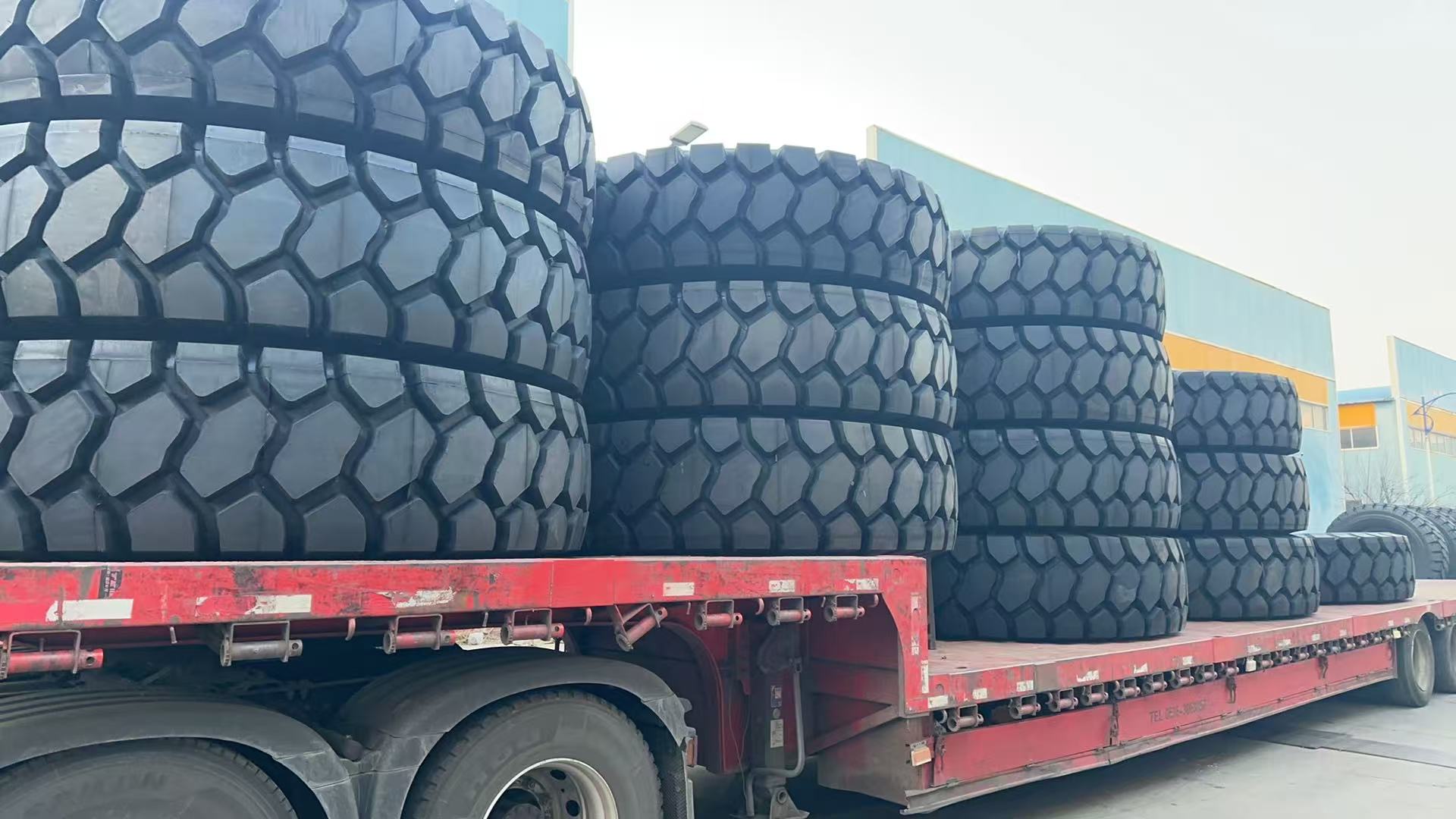
If you operate wheel loaders, you already know the number: 23.5-25. It is the most widely used OTR tire size on mid-size loaders worldwide — the default fitment on machines like the Cat 950 series, Komatsu WA380, Volvo L110, and their Chinese equivalents. Yet many buyers order it year after year without fully understanding what the designation means, which tread depth option suits their site, or when a neighboring size would actually serve them better.
This guide puts the 23.5-25 under the microscope: how to read the size, what machines and duties it fits, the tread options available, and how it compares with the sizes on either side of it.
What Does 23.5-25 Mean?
The designation breaks into two parts:
- 23.5 — the tire’s section width in inches (approx. 596 mm across its widest point, sidewall to sidewall, unloaded);
- 25 — the wheel rim diameter in inches.
So a 23.5-25 tire is roughly 23.5 inches wide and mounts on a 25-inch rim. Its overall inflated diameter is typically around 1,615–1,630 mm depending on brand and pattern, giving a static loaded radius near 750 mm. If you see 23.5R25 instead, the “R” simply means radial construction rather than bias — the physical dimensions are designed to be equivalent, but the carcass and performance profile differ, as we cover below.
Standard dimension and load-index conventions for this size follow the published tables of the Tire and Rim Association and ETRTO; always verify the exact figures for your specific brand and pattern against the sidewall marking and the manufacturer’s data sheet before ordering.
23.5-25 Tire Specs at a Glance
| Spec | Typical Value (verify per brand) |
| Section width | 23.5 in (≈596 mm) |
| Rim diameter | 25 in |
| Rim width | 17.00/2.5 (or 19.00/2.5 on some patterns — check) |
| Overall diameter | ≈1,615–1,630 mm |
| Typical load capacity | ~9.5–12.5 t per tire at standard pressures (load index and star rating dependent) |
| Common speed symbol | A2–A8 (10–40 km/h range per application) |
| Typical machine weight class | 15–22 t operating weight loaders |
| Constructions available | Bias (23.5-25) and radial (23.5R25) |
| Tread options | L2, L3, L4, L5 (and L5S smooth) |
⚠️ Load capacity varies significantly with the tire’s star rating/ply rating, pattern, and the applied pressure. Never mix tires of different load index on the same axle, and never inflate to “what feels right” — use the machine manufacturer’s axle-load table.
Which Machines Use the 23.5-25?
The 23.5-25 is the workhorse of the medium wheel loader class:
| Machine Class | Typical Models | Duty |
| Medium wheel loaders (4–6 m³ bucket) | Cat 950/962, Komatsu WA380/WA470, Volvo L110/L120, XCMG XC958, LiuGong CLG856 | Loading trucks, stockpile, quarry face |
| Telehandlers (heavy) | Some 20 t-class lifting configurations | Material handling on rough sites |
| Compactors / dozers (small) | Certain padfoot and track-type conversions | Site prep |
| Graders (light duty, regional) | Selected medium graders | Road maintenance |
Its sweet spot is the loading cycle: heavy bucket loads, frequent reversals, and constant turning. That is also why the tread depth question matters so much for this size.
Choosing the Right Tread Depth: L2 to L5
Tread depth is the single biggest performance lever on a 23.5-25. The L-codes tell you how much rubber sits between the road and the casing:
| Tread Code | Approx. Depth | Best Application | Trade-off |
| L2 | Standard (~38 mm) | Soft, sandy, low-cut surfaces | Fastest heat dissipation, least cut protection |
| L3 | Extra (~48 mm) | General construction, mixed soil and gravel | The default all-rounder for most buyers |
| L4 | Deep (~62 mm) | Sharp rock, quarry, demolition | More cut resistance; runs hotter, heavier |
| L5 | Super-deep (~83 mm) | Severe rock, slag, scrap yards | Maximum casing protection; slow speed duty only, highest heat risk |
A common and costly mistake is specifying L5 everywhere “for maximum life.” On a loader doing fast stockpile cycles, the extra 35 mm of rubber acts as insulation: internal heat climbs, the compound degrades, and the tire loses life instead of gaining it. The rule of thumb — deeper tread requires slower cycles — applies directly. If your site is abrasive gravel or rock, read our analysis of why loader tires wear out fast on gravel before defaulting to the deepest option.
23.5-25 (Bias) vs 23.5R25 (Radial)
| Factor | 23.5-25 Bias | 23.5R25 Radial |
| Carcass | Crossed nylon plies | Steel belts + radial plies |
| Ride & stability | Stiffer, more wobble at speed | Better traction, smoother, more stable |
| Heat dissipation | Good at low speed | Excellent — supports longer cycles |
| Tread wear rate | Faster, less uniform | Slower and more even |
| Cut resistance | Robust sidewall, forgiving of impacts | Better overall in rocky conditions with protective features |
| Retreadability | Limited | High — quality casings retread 2–3 times |
| Purchase price | Lower | Higher upfront, usually lower cost per hour |
| Best fit | Low-speed, budget, mixed/legacy fleets | Quarries, hard loading faces, high-hour fleets |
On high-hour loaders, radial 23.5R25 almost always wins on cost per hour once wear rate, fuel, and retreading are counted — industry cost analyses tracked by Tyrepress consistently show radial OTR casings carrying the retread economics of modern fleets. Bias remains a rational choice for low-annual-hour machines where the upfront saving outweighs the hourly-rate advantage.
How the 23.5-25 Compares With Neighboring Sizes
| Size | Typical Loader Class | Key Difference vs 23.5-25 |
| 20.5-25 | 12–16 t loaders (Cat 938 class) | ~3 in narrower, lower load capacity, lighter machines |
| 23.5-25 | 15–22 t loaders (Cat 950 class) | The benchmark middle size |
| 26.5-25 | 20–26 t loaders (Cat 966/972 class) | Wider, taller, higher load, different rim (19.00/2.5) |
| 26.5R29 | Larger loaders with taller sidewall | Larger diameter than 26.5-25 — not interchangeable |
Sizes are not interchangeable: a 23.5-25 and a 26.5R25 differ in both width and overall diameter, and swapping requires different rims with axle-load and gearing consequences. We break this down dimension-by-dimension in 23.5-25 vs 26.5R25: Which Size Fits Your Loader?. If you are still building the fundamentals, start with How to Choose the Right Wheel Loader Tire Size and What Is an OTR Tire?.
Buying Tips for 23.5-25 Tires
- Match the tread to the surface, not to habit. L3 for mixed sites, L4/L5 only for genuinely severe rock with slow cycles.
- Check the rim spec. Most 23.5-25 patterns are designed for 17.00/2.5 rims, but some wide-base patterns expect 19.00/2.5 — a mismatched rim voids performance claims.
- Buy in complete sets per axle. Mixing brands, patterns, or remaining tread depths on the same axle causes differential loads and drivetrain strain.
- Inspect casings from day one if you plan to retread. A radial casing run underinflated for even a few weeks may be unfit for a second life — pressure discipline is documented as the single biggest casing killer in OTR fleets.
- Confirm the certification trail. Reputable suppliers provide load/pressure tables traceable to TRA/ETRTO standards and consistent compound documentation — two of the ten criteria in our OTR tire supplier evaluation guide.
FAQ
1. What machines use a 23.5-25 tire? Primarily medium wheel loaders of 15–22 t operating weight — Cat 950/962, Komatsu WA380/WA470, Volvo L110, XCMG XC958, LiuGong CLG856 — plus some heavy telehandlers and compact graders.
2. What is the difference between 23.5-25 and 23.5R25? The “-25” version is bias construction; the “R25” is radial. Dimensions are equivalent, but radials offer better traction, cooler running, slower wear, and higher retreadability at a higher purchase price.
3. How much does a 23.5-25 tire weigh? Typically 240–320 kg depending on construction and tread depth, with L5 bias patterns at the top of the range. Confirm the exact figure for shipping calculations with your supplier.
4. Which tread depth should I choose: L3 or L4? Choose L3 for general construction and mixed surfaces; move to L4 when sharp rock dominates your cycle. Reserve L5 for severe, slow-speed rock duty — it insulates heat and shortens life on fast cycles.
5. Can a 23.5-25 replace a 26.5R25? No. The 26.5R25 is wider and taller, uses a 19.00/2.5 rim, and carries higher loads. Interchanging requires rim changes and alters axle load and machine geometry.
6. What pressure should a 23.5-25 tire run? There is no universal figure — inflation must come from the machine manufacturer’s axle-load table for your bucket and application, cross-checked against the tire brand’s load/pressure data.
7. How long do 23.5-25 loader tires last? Typically 2,000–5,000 hours depending on surface abrasiveness, loading technique, and pressure discipline; see our detailed loader tire lifespan guide for application-by-application figures.
8. Are Chinese-made 23.5-25 tires reliable? Quality varies widely between manufacturers. Judge by verifiable load-index documentation, consistent compound specs, reference fleets on comparable duty, and warranty terms — not price alone. Explore our 23.5-25 loader tire range or contact our specialists for size-specific recommendations.
Summary
- 23.5-25 = 23.5 in section width on a 25 in rim — the benchmark size for 15–22 t medium wheel loaders such as the Cat 950 class and Komatsu WA380.
- Tread depth is the key decision: L3 is the all-round default; L4/L5 only pay off on severe rock with slow cycles, because extra rubber traps heat.
- Radial (23.5R25) usually beats bias on cost per hour for high-hour fleets, thanks to cooler running and retreadable casings; bias still makes sense for low-hour machines.
- Sizes are not interchangeable — moving to 26.5R25 or down to 20.5-25 involves rims, axle loads, and machine fitment.
- Always confirm rim spec, load/pressure tables, and certification before ordering, and buy complete axle sets.