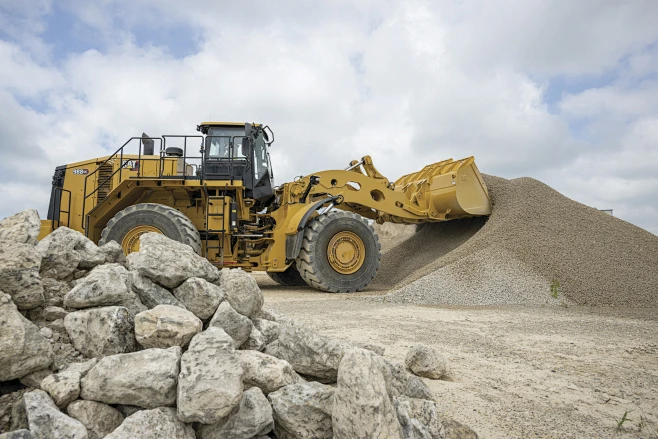
If your wheel loader spends its day in a gravel pit, you already know the story: tires that should last 3,000–5,000 hours are shot in 1,500. Gravel is the single most abrasive surface a loader tire will ever face — harder than quarry rock in some ways, because it moves, cuts, and grinds from every angle at once.
The good news? Fast wear on gravel is rarely a mystery. It almost always traces back to a handful of identifiable causes, and most of them are fixable without replacing the whole fleet. This guide breaks down the 7 reasons loader tires wear out fast on gravel, then gives you the practical countermeasures that fleet managers use to stretch tread life on the toughest surfaces.
Why Is Gravel So Hard on Loader Tires?
Gravel attacks a tire in three distinct ways:
1. Abrasion — the constant grinder
Gravel is typically crushed granite, basalt, or limestone — rock with sharp, freshly fractured edges that rank high on the Mohs hardness scale. Every rotation, those edges scrub against the tread like sandpaper. Unlike smooth dirt or asphalt, gravel never “polishes” — new sharp edges are exposed as the material shifts under the machine. This is why tread rubber compound hardness matters more on gravel than on almost any other surface.
2. Cutting and chipping — the tread killer
The second wear mechanism is worse than abrasion. Individual stones wedge into tread grooves and act as chisels. Every time the tread flexes, the stone levers out a chunk of rubber — the classic “chunking” pattern you see on gravel-pit tires. Deep L4/L5 treads suffer less because there is simply more rubber to sacrifice, but no tread is immune.
3. Penetration — the sidewall threat
Sharp gravel thrown up by the bucket, or pressed between tire and ground, can cut through the sidewall or shoulder. A cut that reaches the casing means the tire is done — retreading is no longer possible. This is where most of the premature (non-wear) tire losses on gravel sites actually come from.
These three mechanisms compound each other, which is why gravel sites can consume tires 2–3 times faster than dirt or concrete surfaces.
The 7 Root Causes of Fast Loader Tire Wear on Gravel
1. Wrong tread depth for the application
A standard L3 (rock) tread is about 1.5× the depth of a normal traction tread. On gravel, that is often not enough. An L4 (2.5×) or L5 (3.5×) tread gives the tire more rubber to burn through before the casing is exposed — and thicker tread blocks also resist chunking better because there is more mass behind each block. If your tires are wearing out on gravel at what feels like record speed, tread depth is the first thing to check. (We cover the full L3/L4/L5 comparison in our wheel loader tire size guide.)
2. Underinflation — the hidden wear accelerator
Every 10% a tire is underinflated, its wear rate rises sharply. Low pressure makes the tread flex more, which:
- Generates heat that softens the rubber (softer rubber abrades faster)
- Exposes the shoulder to gravel contact it was never designed for
- Lets stones dig deeper into the grooves
Run a 23.5-25 loader tire at 25 PSI below spec and you can cut its life nearly in half. Gravel operations should check pressure weekly at minimum — daily for high-hour machines.
3. Overloading the machine
Gravel is dense. A heaped bucket of wet gravel can push a loader past its rated payload, and the overload goes straight into the tires. Beyond a tire’s load index, the casing deflects too much, heat builds up, and wear accelerates dramatically. Overloaded tires also chunk faster because the tread is pressed so hard into the gravel bed that stones are forced into the grooves.
4. Spin and slip
Wheel spin is pure tread destruction. Every second the tire spins against gravel, it grinds off rubber at many times the rate of normal rolling. Common spin sources on gravel sites:
- Aggressive bucket entry at full throttle
- Operating on grades with a full bucket
- Poor traction matching (bias tires on surfaces that need radial grip)
5. Wrong tire construction (bias where radial belongs)
Bias tires have stiffer, cross-ply casings that resist cut damage — but their rigidity creates a smaller, more concentrated footprint, which concentrates wear. Radial tires flex more, put a longer footprint on the ground, and distribute wear over more tread area. On hard-packed gravel, radials typically deliver 20–30% more tread life. The trade-off, cut resistance, is covered in our 23.5-25 vs 26.5R25 comparison, where rim and construction differences determine what fits your loader.
6. Heat buildup
Gravel sites are often hot, open, and fast-paced. Heat is a tire’s silent enemy: it degrades the rubber compound, accelerates chemical wear, and can separate the tread from the casing. Underinflation and overloading both feed the heat cycle — which is why causes #2 and #3 multiply rather than add.
7. Site conditions you can partially control
- Gravel type: freshly crushed granite cuts far worse than rounded river gravel
- Haul road condition: rutted, rock-strewn haul roads punish tires more than a well-maintained pit floor
- Turn patterns: tight, constant 180° bucket cycles grind the shoulder on one side
Gravel Wear: Quick Diagnosis Table
| Symptom | Likely cause | Fix |
| Even wear across tread, fast overall | Abrasion + soft compound | Upgrade to deeper L4/L5 tread |
| Center ribs worn smooth | Chronic overinflation | Reset to spec pressure, verify with gauge |
| Both shoulders worn, center OK | Chronic underinflation | Inflate to spec, check for slow leaks |
| Chunked / torn tread blocks | Stone chiseling + overload | Deeper tread, reduce spin, verify payload |
| One-sided shoulder wear | Consistent tight turning | Widen cycle pattern, rotate tires |
| Sidewall cuts and sniping | Gravel throw + penetration | Thicker sidewall spec, check deflector plates |
| Flat spots / heat checks | Heat + overloading | Reduce load, allow cool-down, review PSI |
How to Slow Down Gravel Wear — 8 Proven Countermeasures
1. Spec the deepest tread the machine allows
On gravel, move up to L5 (or L5S) wherever the machine’s speed profile allows. Deep treads last longer, resist chunking, and remain retreadable. Since most loaders in gravel pits operate under 10 km/h, the heat penalty of deep tread is minimal. Explore deep-tread options in our loader tire lineup.
2. Set pressure by application — and re-check weekly
Use the pressure specified for your load and speed, not the number stamped on the sidewall (that is the maximum for the maximum load). If your loads are consistently below rated, you may be able to run slightly lower pressure for a bigger footprint and better wear distribution — but confirm with the tire manufacturer first. As a general reference on OTR load and pressure standards, the U.S. Tire Manufacturers Association publishes industry engineering data sheets.
3. Match the tire to the gravel
Ask your supplier where the gravel comes from. Crushed granite calls for cut-resistant compounds and deep tread; rounded river gravel is gentler and may not justify the L5 premium. If you are evaluating suppliers, this kind of application-specific spec support is one of the key things to look for — our OTR fundamentals guide explains the specs to request.
4. Kill the spin
Train operators to enter the pile square-on and at moderate throttle. If spin persists on grades, consider a more aggressive tread pattern or check whether radial tires would give better grip. The fuel savings alone often pays for the change.
5. Control the haul road
A 30-minute daily grader pass on haul roads removes the rocks that cause sidewall sniping and penetration. This is the cheapest tire maintenance you will ever do.
6. Rotate and inspect on a schedule
Rotate tires (especially if your site has a dominant turning direction) to even out shoulder wear. Inspect daily for embedded stones — a stone left in a groove becomes a chisel that deepens its own pocket within hours.
7. Track wear rate per position
Measure tread depth monthly and log it per wheel position. A tire that is wearing at twice the fleet rate tells you something: overload on that axle, a spin habit, or an alignment issue. Data catches problems your eyes will miss.
8. Plan for retreading
A sound casing can be retreaded 2–3 times, cutting cost per hour dramatically. That only works if you pull the tire before the casing is damaged — which is exactly what the practices above protect. Retreading is also the industry’s biggest sustainability lever, as Tyrepress reports in its ongoing coverage of casing and retread economics; when casings are finally spent, responsible tire recycling recovers material rather than sending it to landfill.
Gravel Tire Management: What Good Looks Like
| Practice | Poor | Good |
| Tread depth | L3 standard | L4/L5 on high-abrasion gravel |
| Pressure checks | “When it looks low” | Weekly, logged, cold-tire gauge |
| Haul road | Rock-strewn, rutted | Graded daily, stones cleared |
| Operator technique | Full-throttle pile entry | Square-on, moderate throttle |
| Wear tracking | “Replace when flat” | Monthly tread-depth log per position |
| Pull point | Down to cord | At retreadable depth, casing intact |
FAQ
How long should loader tires last on gravel? On high-abrasion crushed gravel, 2,000–3,500 hours is typical for a quality L4/L5 tire with correct pressure and no abuse. On gentler river gravel with good site management, 4,000–6,000 hours is achievable. If you are getting significantly less, one of the seven causes above is usually to blame.
Is L5 tread worth the extra cost on gravel? Usually yes. The deeper tread costs 15–25% more upfront but can deliver 40–60% more hours on abrasive gravel, so the cost per hour is lower. The main exception is a machine that travels at higher speeds between sites, where deep-tread heat buildup becomes a factor.
Does tire pressure really make that much difference on gravel? It is often the single biggest controllable factor. Underinflation accelerates wear through heat, shoulder exposure, and stone penetration — and it also increases fuel consumption. A weekly cold-pressure check is the highest-return maintenance task on any gravel site.
Bias or radial tires for gravel work? Both have a place. Bias tires have stiffer sidewalls that resist cuts — useful on sharp, freshly crushed rock. Radial tires run cooler, wear more evenly, and generally deliver more tread life on hard-packed gravel. Many gravel operators run radials on loaders and keep bias for machines facing severe cut risk.
Can I retread a gravel-worn loader tire? Yes — if you pull it in time. The casing must be free of section repairs, sidewall cuts, and heat damage. A tire worn to the wear line on gravel with an intact casing is an excellent retread candidate and is exactly what a scheduled wear-tracking program protects.
Why do my loader tires wear on one side faster? Almost always the turning pattern. Loaders doing repetitive 180° cycles grind the same shoulder every pass. Rotating tires side-to-side at mid-life evens this out and can extend total tire life 10–20%.
Do gravel-type tires exist — tires made specifically for gravel? There are tread patterns and compounds optimized for high-abrasion surfaces (deep rock treads, cut-resistant compounds), and OEM TKPH/TMPH ratings that indicate how much work a tire can absorb as heat. Match the tire’s rating to your site’s load-and-speed cycle rather than buying on price alone.
Where do I start if wear is already out of control? In order: check actual inflation against spec, verify payload versus the machine’s rated capacity, move up one tread depth on the next replacement cycle, and start a monthly tread-depth log. Those four steps fix the majority of fast-wear cases. If you need help reading your wear pattern, contact our tire specialists with photos and we will tell you what it indicates.
Summary
Gravel wears loader tires fast through three mechanisms — abrasion, cutting, and penetration — and seven root causes: shallow tread, underinflation, overloading, wheel spin, wrong construction, heat, and site conditions. The fixes are mostly operational rather than capital-intensive:
- Spec L4/L5 deep tread for high-abrasion gravel
- Check pressure weekly — the highest-return habit on any site
- Stop overloading and kill wheel spin through operator technique
- Grade haul roads and clear embedded stones daily
- Track tread depth monthly and pull tires while casings are still retreadable
Do these five things and doubling your current gravel tire life is a realistic target, not a sales pitch.
Next step: browse the Kebek loader tire range for deep-tread L4/L5 options, or talk to our specialists about a wear audit on your current fleet.