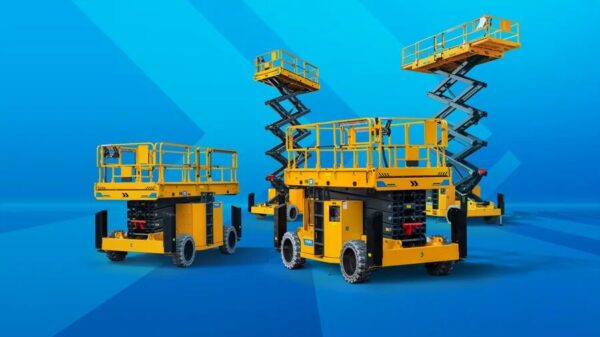
A scissor lift is a vertical aerial work platform that raises personnel and materials to heights of 15 to 50+ feet. Unlike boom lifts that articulate outward, scissor lifts extend straight up — which means the entire machine’s base, including all four tires, remains on the ground while workers are elevated. If a tire fails, deflates, or loses traction while someone is working at height, the platform can tilt, shift, or collapse. That is why the question “what tire does a scissor lift use?” is not a casual specification inquiry — it is a safety-critical decision that affects operator protection, machine uptime, floor surface protection, and total cost of ownership.
Scissor lifts operate in an extraordinarily wide range of environments: polished warehouse floors, construction sites littered with nails and rebar, outdoor gravel lots, port terminals, aircraft hangars, and food-processing facilities. No single tire type is optimal for all of these conditions. This guide explains every tire type used on scissor lifts, why the choice matters, how to identify the right tire for your application, common sizes and brand compatibility, and the warning signs that tell you it is time to replace them.
[Link to: Scissor Lift Tire Product Page]
What Tires Do Scissor Lifts Use?
Scissor lifts use four primary tire types. The correct type depends on the machine’s design (slab vs. rough-terrain), the power source (electric vs. diesel), and the primary operating environment (indoor vs. outdoor).
The Four Scissor Lift Tire Types
| Tire Type | Construction | Air Required? | Puncture-Proof? | Typical Machine | Typical Environment |
| Solid (Resilient) | Molded rubber bonded to a steel band; no air chamber | No | Yes | Electric slab scissor lifts | Indoor — warehouses, factories, retail |
| Pneumatic (Air-Filled) | Rubber casing with compressed air (tube or tubeless) | Yes | No | Rough-terrain diesel scissor lifts | Outdoor — construction, gravel, dirt |
| Foam-Filled (PU-Filled) | Pneumatic casing injected with cured polyurethane gel | No | Yes | Rough-terrain or mixed-use lifts | Outdoor + indoor hybrid sites |
| Non-Marking Solid | Solid rubber with silica-based white/light-gray compound | No | Yes | Electric scissor lifts | Indoor — food, pharma, retail, cleanrooms |
Slab vs. Rough-Terrain Scissor Lifts: The Fundamental Split
Understanding the tire choice starts with understanding the two basic categories of scissor lifts:
| Feature | Slab Scissor Lift | Rough-Terrain Scissor Lift |
| Power Source | Electric (battery) | Diesel or gas-electric hybrid |
| Drive System | 2WD | 4WD |
| Platform Height | 15–40 ft | 30–50+ ft |
| Factory Tire | Solid (smooth or non-marking) | Pneumatic (aggressive tread) |
| Ground Clearance | Low (4–6 in) | High (8–12 in) |
| Max Slope Rating | 2–5° | 20–30° |
| Primary Use | Smooth, level indoor surfaces | Uneven outdoor terrain |
| Typical Weight Capacity | 500–900 lb | 1,000–2,500 lb |
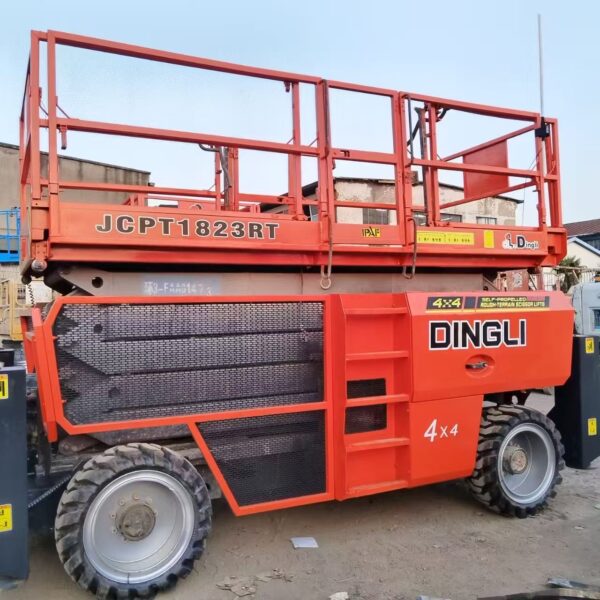
Most slab lifts ship from the factory with solid tires because they will never leave a smooth concrete floor. Most rough-terrain lifts ship with pneumatic tires because they need traction, shock absorption, and flotation on uneven ground. However, many operators modify their machines — swapping pneumatics for foam-filled or solid tires when their “outdoor” lift turns out to spend most of its time on debris-covered slabs.
Why Does the Scissor Lift Tire Matter?
1. Operator Safety at Height
This is the single most important reason. When a scissor lift is elevated, the platform’s stability depends entirely on the four contact patches where the tires meet the ground. Consider what happens if a tire fails at height:
| Failure Mode | What Happens | Risk Level |
| Pneumatic tire blowout | Sudden loss of one corner; platform tilts 3–8° instantly | Critical — potential ejection of personnel |
| Slow pneumatic leak | Tire softens over hours; platform becomes unstable under load | High — may go unnoticed until loaded |
| Solid tire chunking | Pieces of rubber break off; uneven contact patch | Medium — progressive, usually detectable |
| Tire slipping on wet/smooth floor | Platform slides laterally under wind or load shift | High — especially near edges or overhead hazards |
| Foam-filled casing tear | Polyurethane extrudes; tire goes soft | Medium — slower than air loss but still destabilizing |
A single tire failure at 35 feet can cause the platform to tilt enough to trigger the tilt alarm, disable the drive function, and require an emergency lowering procedure — or worse, cause a tip-over. This is why OSHA requires daily pre-use inspections of aerial lift tires and why most rental companies will not release a machine with a tire in questionable condition.
2. Floor Surface Protection
In environments like retail stores, shopping malls, hospitals, food-processing plants, and pharmaceutical cleanrooms, the floor surface itself is a high-value asset. Standard black rubber tires leave carbon-based marks that are difficult and expensive to remove. The table below shows the floor-marking performance of different tire compounds:
| Tire Compound | Marking on Polished Concrete | Marking on Epoxy Coating | Marking on VCT/Vinyl | Typical Application |
| Standard Black Solid | Visible black streaks | Permanent black marks | Permanent black marks | Outdoor, industrial |
| Non-Marking (Silica-Based) | No marks | No marks | No marks | Retail, food, pharma, cleanrooms |
| Gray Semi-Marking | Light marks, removable | Faint marks | Light marks | Warehouses with mixed floor types |
| Pneumatic (Black) | Moderate marks | Visible marks | Visible marks | Outdoor only |
3. Uptime and Productivity
Flat tires are one of the top three causes of unplanned scissor lift downtime on construction sites, alongside battery/electrical failures and hydraulic leaks. A single flat pneumatic tire can take a machine out of service for 2–8 hours while a replacement is sourced, the machine is jacked up, and the tire is mounted. On a busy job site where the lift is on the critical path, this delay cascades into schedule overruns and labor cost overruns.
| Tire Type | Average Flat-Related Downtime per Year | Maintenance Hours per Year | Replacement Frequency |
| Pneumatic | 8–24 hours | 12–20 hours (pressure checks, repairs) | Every 12–18 months |
| Foam-Filled | 0–2 hours | 2–4 hours (visual inspection) | Every 18–30 months |
| Solid | 0 hours | 1–2 hours (visual inspection) | Every 24–48 months |
4. Total Cost of Ownership (TCO)
The upfront cost of a scissor lift tire is only 15–25% of its total cost of ownership. The real cost is in maintenance, downtime, and replacement frequency.
| Cost Factor (per tire, 3-year period) | Pneumatic | Foam-Filled | Solid |
| Initial Purchase | $80–150 | $180–280 | $120–250 |
| Air Pressure Maintenance (labor) | $60–120 | $0 | $0 |
| Flat Repairs | $40–100 | $0 | $0 |
| Downtime Cost (at $85/hr lost productivity) | $680–2,040 | $0–170 | $0 |
| Replacement Tires (if needed within 3 years) | $80–150 | $0 (usually lasts) | $0 (usually lasts) |
| 3-Year Total Cost | $940–2,610 | $180–450 | $120–250 |
The data is clear: solid and foam-filled tires deliver dramatically lower TCO despite higher upfront costs, primarily by eliminating the downtime and maintenance burden of pneumatic tires.
5. Regulatory and Insurance Compliance
Many facilities — particularly food processing (USDA, FDA), pharmaceuticals (GMP), and aerospace — require non-marking tires as a condition of entry. Operating a scissor lift with standard black tires in these environments can result in:
- Failed facility audits and inspection citations
- Denied entry to job sites (contractors sent home)
- Damage claims for floor restoration ($500–5,000 per incident)
- Insurance premium increases after repeat incidents
How to Identify Which Tire Your Scissor Lift Needs
Step 1: Determine Your Machine Type
Check the data plate on your scissor lift. It will specify whether the machine is a slab model (usually electric, marked “indoor use only” or “slab only”) or a rough-terrain model (usually diesel, marked “4WD” or “RT”).
Step 2: Assess Your Primary Operating Environment
| If You Operate On… | Recommended Tire | Why |
| Polished concrete, epoxy, tile, VCT | Solid non-marking | Floor protection; zero flats; maximum stability |
| Smooth concrete with debris (construction slab) | Solid or foam-filled | Puncture-proof; handles nails, screws, glass |
| Gravel, dirt, grass, uneven ground | Pneumatic or foam-filled | Traction, flotation, shock absorption |
| Mixed indoor/outdoor (60/40 or 40/60) | Foam-filled | Puncture-proof with ride comfort |
| Steel grating or checker plate | Solid with smooth tread | Pneumatic can pinch and rupture on grating edges |
| Food/pharma/cleanroom | Solid non-marking (white) | Regulatory compliance; no carbon marks |
Step 3: Check Your Current Tire Size
Scissor lift tire sizes are printed on the sidewall. The most common sizes are:
| Common Size | Typical Application | Approx. Outer Diameter | Approx. Tread Width |
| 10×3.5 (solid) | Electric slab lifts (Genie GS-1930, Skyjack SJIII 3226) | 10 in | 3.5 in |
| 13×5 (solid) | Larger electric slab lifts (Genie GS-2632, JLG 1932) | 13 in | 5 in |
| 15×5 (solid) | Heavy-duty electric lifts (Genie GS-3246, Skyjack SJIII 4632) | 15 in | 5 in |
| 25×10-12 (pneumatic) | Rough-terrain lifts (Genie GS-3390 RT, JLG 3397) | 25 in | 10 in |
| 27×10-12 (pneumatic) | Large rough-terrain lifts (Skyjack SJ9263 RT, Haulotte HS18) | 27 in | 10 in |
| 29×10-14 (pneumatic) | Heavy rough-terrain lifts (Genie GS-4390 RT) | 29 in | 10 in |
Note: Solid tire sizes use a simple “diameter × width” format (e.g., 10×3.5), while pneumatic sizes follow the standard “diameter × width – rim diameter” format (e.g., 25×10-12). Always verify the rim diameter and bolt pattern before ordering replacements.
Step 4: Match to Your Scissor Lift Brand
| Brand | Popular Slab Models (Solid Tire) | Popular RT Models (Pneumatic Tire) | OEM Tire Brand (typical) |
| Genie (Terex) | GS-1930, GS-2632, GS-3246 | GS-3390, GS-4390, GS-2690 | Carlisle, Galaxy, Mitas |
| JLG | 1932, 2032, 2632, 3246 | 3397, 4394, 5394 | Carlisle, Titan, Alliance |
| Skyjack | SJIII 3226, 4632, 6632 | SJ9263, SJ9250, SJ9270 | Carlisle, Solideal |
| Haulotte | HS18, HS22, HS26 | HA16, HA20, HA26 | Michelin, Trelleborg |
| Snorkel | S3219, S3226, S4632 | S3310, S4315, S6215 | Carlisle, Galaxy |
| Niftylift (MEWP) | TD120, TD150 | HR12, HR15, HR21 | Carlisle, Mitas |
Aftermarket compatibility: Kebek Tire manufactures direct-replacement solid, pneumatic, and foam-filled tires for all major scissor lift brands. [Link to: Scissor Lift Tire Product Page]
What Are the Warning Signs That Scissor Lift Tires Need Replacement?
Unlike passenger car tires, scissor lift tires do not have a mileage-based replacement interval. Instead, replacement is triggered by visual and performance indicators. Here are the 7 most common warning signs:
1. Tread Wear to the Wear Indicator
Most solid scissor lift tires have a molded wear line or dimple on the tread surface. When the tread wears down flush with this indicator, the tire has reached its minimum safe diameter. Continuing to use a worn solid tire reduces ground clearance and can cause the tire’s steel band to contact the floor, damaging both the tire and the surface.
2. Chunking or Tearing on Solid Tires
Solid tires operating on rough surfaces or in high-debris environments can develop chunks of missing rubber along the tread or shoulders. Chunking reduces the contact patch, creates vibration, and accelerates further damage. Any chunk deeper than 10 mm or exposing the steel band requires immediate replacement.
3. Cracks, Cuts, or Exposed Cords on Pneumatic Tires
Inspect the sidewall and tread for:
- Cracks deeper than 3 mm — structural degradation
- Cuts exposing nylon or steel cords — blowout risk
- Bulges or blisters on the sidewall — internal ply separation
- Embedded objects (nails, screws, wire) that cannot be safely removed
4. Irregular or Uneven Wear Patterns
| Wear Pattern | Likely Cause | Action |
| Center wear (crown) | Overinflation | Reduce pressure; check alignment |
| Shoulder wear (both sides) | Underinflation | Increase pressure; check for slow leak |
| One-sided wear | Axle misalignment or bearing wear | Align axle; replace bearings |
| Cupping / scalloping | Worn suspension or balance issue | Inspect hub and spindle |
| Flat spots | Hard braking or skidding | May resolve with use; monitor |
5. Loss of Pressure (Pneumatic Tires)
If a pneumatic tire loses more than 3–5 PSI per week without an identifiable puncture, the valve stem, bead seal, or casing may be compromised. Repeated reinflation is a temporary fix — the tire should be inspected by a professional and likely replaced.
6. Vibration or Wobble at Height
If the platform vibrates or wobbles when elevated, the tires are a primary suspect. A flat spot, chunked area, or out-of-round tire creates cyclic vibration that is amplified at height. This is not just a comfort issue — it can cause the tilt alarm to trigger intermittently and may indicate a tire that is close to failure.
7. Foam Extrusion (Foam-Filled Tires)
If you see polyurethane gel squeezing out through a crack or cut in a foam-filled tire, the casing has been compromised. The tire will progressively lose its rigidity and must be replaced. Do not attempt to patch foam-filled tires — the casing is no longer structurally sound.
How to Maintain Scissor Lift Tires for Maximum Lifespan
Proper maintenance can extend scissor lift tire life by 30–50% and prevent safety-critical failures:
| Maintenance Task | Frequency | What to Check | Time Required |
| Visual inspection | Daily (pre-use) | Cuts, chunks, embedded objects, pressure (pneumatic) | 2 min per tire |
| Pressure check (pneumatic) | Weekly | Correct PSI per machine manual | 1 min per tire |
| Tread depth measurement | Monthly | Compare to wear indicator | 1 min per tire |
| Wheel bolt torque | Monthly | All wheel nuts at spec torque | 3 min per wheel |
| Tire rotation | Every 6 months | Swap front-to-back if uneven wear | 20 min per machine |
| Foam-fill inspection | Quarterly | Casing integrity, gel extrusion signs | 2 min per tire |
| Non-marking compound check | Monthly | Floor marks appearing where none existed before | Visual |
| Full tire assessment | Annually or at major service | Professional inspection; replacement planning | 30 min per machine |
Best Practices
- Never mix tire types on the same machine. Different tire types (solid, pneumatic, foam-filled) have different rolling diameters and spring rates. Mixing them creates uneven loading, steering pull, and platform instability.
- Replace tires in pairs (minimum) or sets of four (preferred). A single new tire paired with three worn tires creates a height differential that affects platform level.
- Keep tires clean. Concrete dust, metal shavings, and chemical spills degrade rubber over time. Wipe tires during routine cleaning.
- Store spare tires properly. Solid tires should be stored flat in a cool, dry area away from direct sunlight and ozone sources (electric motors, welding equipment). Pneumatic tires should be stored vertically, inflated to 50% of operating pressure.
- Train operators to report immediately. Any unusual vibration, wobble, or handling change should trigger an immediate stop and inspection — not “finish the job and report it tomorrow.”

Frequently Asked Questions (FAQ)
Q1: What size tire does a scissor lift use?
The most common scissor lift tire sizes are 10×3.5 (solid, for compact electric slab lifts like the Genie GS-1930), 13×5 (solid, for mid-size electric lifts), 15×5 (solid, for larger slab lifts), and 25×10-12 or 27×10-12 (pneumatic, for rough-terrain diesel lifts). The exact size depends on the machine model, platform height, and load capacity. Always check the sidewall of your current tire or the machine’s manual before ordering replacements. [Link to: Scissor Lift Tire Product Page]
Q2: Can I put solid tires on a rough-terrain scissor lift?
Yes, in many cases you can — but only if the machine primarily operates on relatively flat surfaces (construction slabs, parking lots, compacted gravel). Solid tires will reduce traction and ride comfort on rough terrain, and they transmit more shock to the machine’s drivetrain and scissor mechanism. If your rough-terrain lift spends most of its time on debris-covered flat surfaces, converting to solid or foam-filled tires is a smart upgrade. If it genuinely works on uneven, rocky, or muddy ground, keep pneumatic or foam-filled tires. [Link to: Industry Application — Construction Page]
Q3: Why do some scissor lift tires leave black marks on the floor?
Standard black solid and pneumatic tires contain carbon black, a reinforcing filler that gives rubber its strength and durability. When the tire slides or skids on a smooth floor — especially during sharp turns — carbon particles transfer to the surface, leaving black streaks. Non-marking tires replace carbon black with silica, producing a white or light-gray compound that leaves no marks. Non-marking tires are required in retail, food processing, pharmaceutical, and cleanroom environments. [Link to: Forklift Tire Product Page]
Q4: How often should scissor lift tires be replaced?
There is no fixed time interval. Solid tires typically last 2,000–4,000 operating hours (roughly 2–4 years in normal use), foam-filled tires last 1,500–3,000 hours, and pneumatic tires last 800–1,500 hours (shorter due to punctures and pressure maintenance issues). Replace tires when they reach the wear indicator, show chunking or cracking, or exhibit any of the warning signs described in this article. Inspect daily and plan replacements proactively rather than waiting for a failure.
Q5: What is the difference between foam-filled and solid scissor lift tires?
Solid tires are manufactured as a single molded piece of rubber bonded to a steel band — there is no air chamber and no casing. They are denser, harder, and provide the most stability but the least shock absorption. Foam-filled tires start as a pneumatic casing that is injected with liquid polyurethane, which cures into a solid gel. They retain the tread pattern and softer ride of a pneumatic tire while being puncture-proof. Foam-filled tires offer a middle ground: pneumatic-level comfort and traction with solid-level puncture immunity. However, they are heavier and harder to mount than solid tires.
Q6: Do I need non-marking tires for my scissor lift?
You need non-marking tires if your scissor lift operates in any of the following environments:
- Retail stores, shopping malls, showrooms
- Food and beverage processing facilities (USDA, FDA regulated)
- Pharmaceutical manufacturing (GMP facilities)
- Cleanrooms and semiconductor fabs
- Hospitals and healthcare facilities
- Buildings with polished, coated, or decorative flooring
If your scissor lift works exclusively outdoors or in industrial environments where floor appearance is not a concern, standard black tires are fine and typically offer slightly better wear resistance.
Q7: Can I replace just one scissor lift tire, or do I need to replace all four?
You should never replace just one tire on a scissor lift. At minimum, replace tires in pairs on the same axle (both front or both rear). Ideally, replace all four at once. A single new tire alongside three worn tires creates a height differential of 5–15 mm, which is enough to cause the platform to sit slightly off-level at full elevation. This can trigger the tilt alarm, restrict platform function, and create uneven stress on the scissor mechanism. If budget is a concern, rotate the best-used tires to one axle and put the new pair on the other.
Q8: Where can I buy replacement tires for my scissor lift fleet?
Kebek Tire manufactures a complete range of solid, non-marking, pneumatic, and foam-filled tires for all major scissor lift brands — including Genie, JLG, Skyjack, Haulotte, Snorkel, and Niftylift. We offer standard black, non-marking white, and traction-tread compounds in all common sizes. Our team can help you match the right tire type and compound to your specific machines and operating conditions. [Reach out for a consultation] and we’ll provide a fleet-level tire assessment.
Conclusion: The Right Tire Makes All the Difference
The tire on a scissor lift is not a consumable afterthought — it is a safety-critical component that determines whether your machine stays productive, protects your floors, keeps operators safe at height, and stays compliant with facility requirements. Here is a summary of the key decision points:
| Your Situation | Recommended Tire | Key Reason |
| Indoor only, smooth floors | Solid non-marking | Floor protection; zero flats; maximum stability |
| Construction slab with debris | Solid (black) | Puncture-proof; durable; zero downtime |
| Outdoor rough terrain | Pneumatic | Best traction and shock absorption |
| Mixed indoor/outdoor | Foam-filled | Puncture-proof + ride comfort |
| Food/pharma/cleanroom | Solid non-marking (white) | Regulatory compliance |
| 24/7 multi-shift operations | Solid | Zero maintenance; always ready |
| Budget-constrained, outdoor only | Pneumatic | Lowest upfront cost |
The bottom line: The right scissor lift tire eliminates downtime, protects personnel at height, preserves floor surfaces, and reduces total cost of ownership by up to 80% over a three-year period compared to running the wrong tire type. The wrong tire — or a worn tire that should have been replaced — is an accident waiting to happen.
Take five minutes today to inspect your scissor lift fleet’s tires. Check the wear indicators, look for chunking or cracks, verify pressure on pneumatics, and note any machines running standard black tires in non-marking environments. If any tire shows warning signs, replace it before the next lift — not after the next incident.
If you need help selecting the right tire type, compound, or size for your scissor lift fleet, [reach out for a consultation]. Our specialists will match your machines and operating conditions to the optimal tire — and provide a fleet-level cost comparison so you can see the savings before you buy.
[External Link to: Kebek Tire Made-in-China Store — https://chinakebektire.en.china.cn — Browse our complete solid tire, scissor lift tire, and foam-filled tire catalog] [External Link to: Kebek Tire Alibaba Store — https://www.alibaba.com/product-detail/High-quality-wheel-loader-tires-23_60779164970.html — Explore solid and aerial lift tires on Alibaba.com]