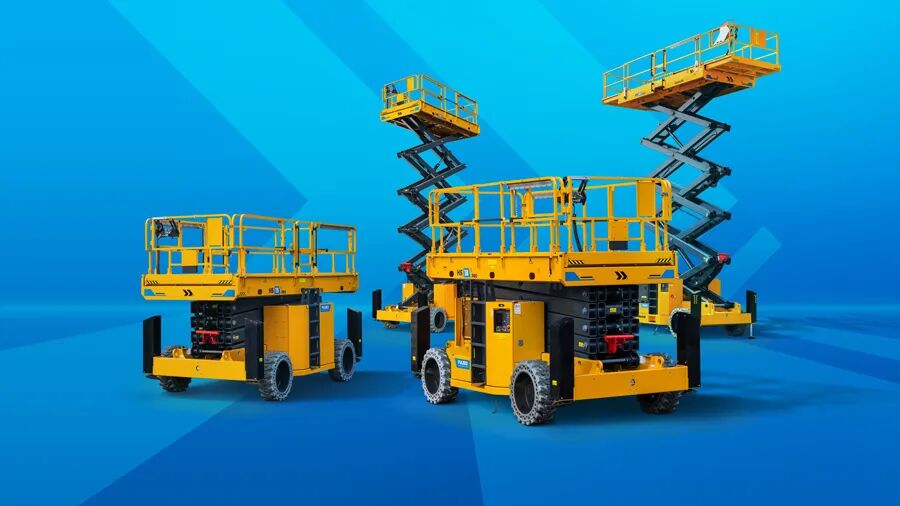
A scissor lift is only as stable as the four tires it stands on. When a tire fails — or worse, deflates while personnel are elevated 30–40 feet in the air — the consequences range from costly downtime to serious safety incidents. That’s why the choice between solid and pneumatic tires on a scissor lift is not a minor specification detail; it is a decision that affects uptime, maintenance costs, operator safety, and total cost of ownership.
The market is split. OEMs ship some scissor lifts with pneumatic tires for outdoor rough-terrain use, and others with solid tires for indoor and high-debris environments. Many fleet managers end up with a mixed fleet and are unsure which tire type to standardize on — or whether to convert pneumatics to solid when replacements come due.
This article provides a head-to-head comparison of solid vs pneumatic scissor lift tires across 10 critical dimensions, explains which tire wins in each common application, and gives you a clear framework for making the right call for your fleet.
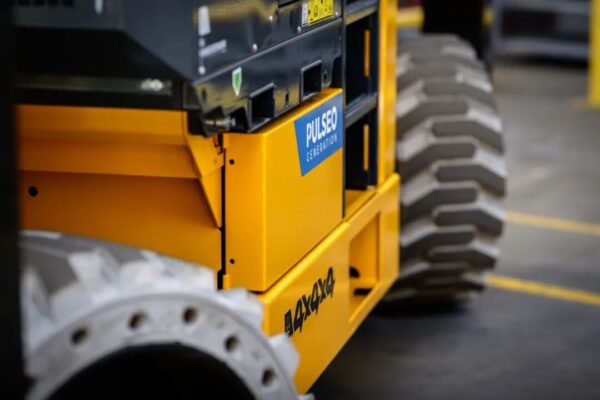
What Tires Do Scissor Lifts Use?
Scissor lifts typically use one of three tire types, depending on the machine’s design and intended environment:
| Tire Type | Construction | Puncture-Proof? | Typical Scissor Lift Application |
| Solid (Resilient) | Molded rubber bonded to a steel band; no air chamber | Yes | Indoor electric scissor lifts, slab models, high-debris sites |
| Pneumatic (Air-Filled) | Rubber casing with compressed air inner tube or tubeless | No | Rough-terrain scissor lifts, outdoor construction sites |
| Foam-Filled (PU-Filled) | Pneumatic casing injected with cured polyurethane | Yes | Compromise: outdoor traction + puncture proofing |
Most slab scissor lifts (electric, indoor-only models) come factory-equipped with solid tires. Most rough-terrain scissor lifts (diesel or gas-electric, 4WD models designed for outdoor use) come with pneumatic tires. The question of “which is better” depends almost entirely on where and how you operate the machine.
[Link to: Scissor Lift Tire Product Page]
Solid vs Pneumatic Scissor Lift Tires: 10-Factor Comparison
| Factor | Solid Tires | Pneumatic Tires | Winner |
| Puncture Resistance | 100% puncture-proof — no air to lose | Vulnerable to nails, rebar, glass, sharp rocks | Solid |
| Downtime Risk | Near-zero tire-related downtime | Flats can sideline the machine for hours | Solid |
| Service Life | 3,000–5,000+ hours (thicker usable tread) | 1,000–2,500 hours (thinner tread, puncture damage) | Solid |
| Ride Comfort | Firmer ride; transmits more vibration | Softer ride; air absorbs shocks | Pneumatic |
| Traction on Rough Terrain | Adequate but limited tread options | Excellent — aggressive tread patterns available | Pneumatic |
| Traction on Wet/Muddy Ground | Limited — cannot air down for flotation | Good — can lower pressure for larger contact patch | Pneumatic |
| Stability at Height | Superior — minimal deflection under load | More tire squirm; machine feels less planted | Solid |
| Maintenance Required | Zero — no pressure checks, no flats to repair | Daily pressure checks; flat repairs; valve replacements | Solid |
| Upfront Cost | Higher (1.5–2.5× pneumatic) | Lower | Pneumatic |
| Total Cost of Ownership | Lower (long life + zero downtime) | Higher (frequent replacement + downtime) | Solid |
The Verdict by Factor Count
- Solid wins: 7 out of 10 factors
- Pneumatic wins: 3 out of 10 factors (ride comfort, rough-terrain traction, upfront cost)
But factor count alone doesn’t tell the full story. The real answer depends on your operating environment.
When Solid Scissor Lift Tires Are the Better Choice
Scenario 1: Indoor and Slab Operations
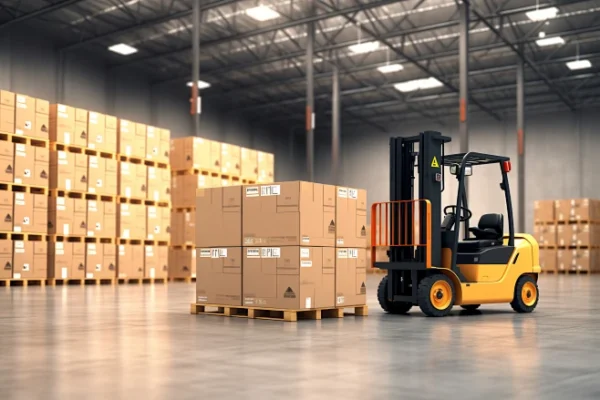
If your scissor lifts operate primarily indoors — warehouses, factories, retail fit-outs, convention centers, parking garages — solid tires are the clear winner. Indoor environments have smooth concrete floors where pneumatic ride comfort offers no advantage, and solid tires provide maximum stability, zero maintenance, and no risk of floor-marking (if you choose non-marking compounds).
Scenario 2: High-Debris Construction Sites
Construction sites with exposed rebar, nails, broken glass, and sharp aggregate are pneumatic tire graveyards. A scissor lift moving through an active construction zone will pick up debris in its tires constantly. On these sites, solid tires (or foam-filled tires) eliminate the flat-tire problem that causes the most unplanned downtime.
Scenario 3: 24/7 or Multi-Shift Operations
In multi-shift operations where the scissor lift runs 16–24 hours per day, there is no time for tire maintenance. Solid tires require zero daily attention — no pressure checks, no flat repairs, no spare tires to swap in. The machine is always ready to work.
Scenario 4: Personnel Safety Is the Top Priority
When personnel are elevated 30–40 feet, tire integrity is a safety-critical issue. A pneumatic tire that slowly loses pressure while the platform is raised creates an unstable base — the machine can tilt, triggering safety alarms or, in worst cases, tipping. Solid tires maintain their shape and load support indefinitely, providing a consistently stable platform.
Scenario 5: Fleets With Limited Maintenance Resources
If your fleet maintenance team is stretched thin, solid tires remove an entire category of maintenance tasks. No pressure checks, no flat tracking, no tire repair scheduling, no valve stem replacements. This frees up maintenance personnel for higher-value work.
When Pneumatic Scissor Lift Tires Are the Better Choice
Scenario 1: Rough-Terrain Outdoor Sites
If your scissor lifts operate on unpaved ground — dirt access roads, gravel pads, muddy construction sites, or rocky terrain — pneumatic tires are the better choice. Their air cushion absorbs shocks from uneven ground, protecting both the operator and the machine’s drivetrain. Aggressive pneumatic tread patterns provide traction that solid tires cannot match.
Scenario 2: Significant Road or Yard Travel
If the scissor lift must travel long distances across a site — for example, moving from a staging area to a work zone 500 meters away — pneumatic tires provide a smoother, faster ride. Solid tires transmit every bump and crack directly to the platform, making long travel uncomfortable for the operator and potentially jarring for the machine’s components.
Scenario 3: Mixed Indoor/Outdoor Use With Comfort Requirements
For fleets that split time between indoor and outdoor work, and where operator comfort over a full shift matters, pneumatic tires offer the best all-around ride quality. The air cushion naturally absorbs impacts that solid tires transmit.
Scenario 4: Budget-Constrained Upfront Purchase
If upfront cost is the primary constraint and the operating environment is not debris-heavy, pneumatic tires cost significantly less at purchase. Just be aware that the lower upfront price is often offset by higher long-term costs from flats, replacements, and downtime.
The Compromise: Foam-Filled (PU-Filled) Scissor Lift Tires
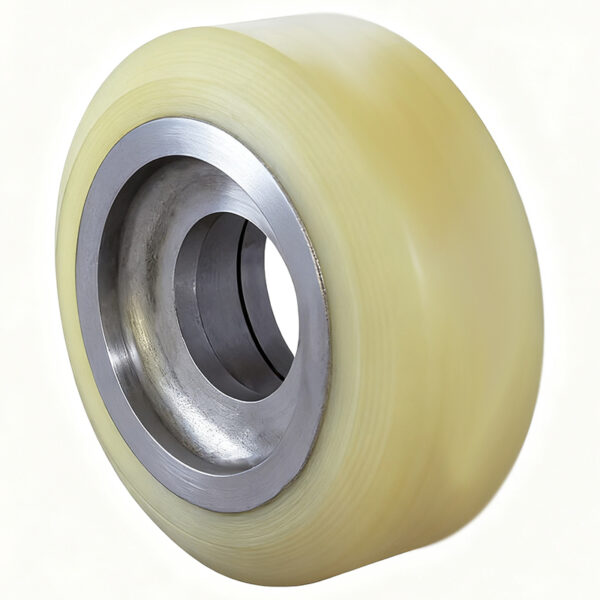
For operators caught between the puncture-proofing of solid tires and the ride comfort and traction of pneumatic tires, polyurethane foam-filled tires offer the best of both worlds.
How Foam-Filled Tires Work
A standard pneumatic tire casing is mounted on the rim normally, then injected with liquid polyurethane resin through the valve stem. The resin cures over 24–72 hours into a dense, resilient elastomer that completely fills the tire’s air cavity. The result is a tire that:
- Cannot go flat — there is no air to lose
- Retains pneumatic tread patterns — full traction capability
- Absorbs shocks — the PU compound has elastic properties similar to air
- Rides like a pneumatic — operators often cannot tell the difference
Foam-Filled vs Solid vs Pneumatic: Quick Comparison
| Factor | Foam-Filled | Solid | Pneumatic |
| Puncture-proof | Yes | Yes | No |
| Ride comfort | Excellent (closest to pneumatic) | Firm | Best |
| Traction options | Full pneumatic tread range | Limited solid tread patterns | Full pneumatic tread range |
| Weight | Heavy (adds 30–50% to tire weight) | Moderate | Lightest |
| Service life | 2,000–4,000 hours | 3,000–5,000+ hours | 1,000–2,500 hours |
| Speed limitation | Recommended ≤25 km/h | Recommended ≤25 km/h | No practical limit |
| Upfront cost | Moderate (pneumatic + fill cost) | Highest | Lowest |
When to Choose Foam-Filled
Foam-filled tires are ideal for:
- Rough-terrain scissor lifts operating on debris-rich construction sites
- Fleets that need pneumatic traction but cannot tolerate flats
- Mixed indoor/outdoor operations where ride comfort matters
- Machines that already have pneumatic rims (foam-filling reuses existing rims)
[Link to: Foam-Filled Tire Product Page]
How to Convert Pneumatic Scissor Lift Tires to Solid
Many fleet managers choose to convert rough-terrain scissor lifts from pneumatic to solid tires when the original pneumatics wear out. Here’s what you need to know:
Step 1: Verify Compatibility
Not all scissor lift rims accept solid tires. Solid tires require a specific rim profile (typically a “solid tire band” or specific bead seat design). Check with the equipment manufacturer or a tire specialist to confirm that solid tires are available for your machine’s rim size.
Step 2: Match the Overall Diameter
The solid tire’s overall diameter must match the original pneumatic tire’s loaded (inflated) diameter within ±3%. A significantly smaller tire reduces ground clearance and can affect drivetrain gearing; a larger tire may rub against fenders or overflow guards.
Step 3: Verify Load Capacity
Solid tires have specific load ratings. Ensure the solid tire’s rated load capacity exceeds the maximum axle load of the scissor lift, including the rated platform load and personnel weight.
Step 4: Consider Non-Marking Compound
If the scissor lift will be used indoors (even occasionally), choose a non-marking solid tire compound. Black solid tires can leave visible scuff marks on light-colored concrete, epoxy, or polished floors — which can result in cleaning charges or contract penalties on some sites.
Step 5: Install in Complete Sets
Always replace all four tires at the same time. Mixing worn pneumatic tires with new solid tires creates uneven ride heights, which can affect the scissor lift’s level-sensing system and trigger false tilt alarms.
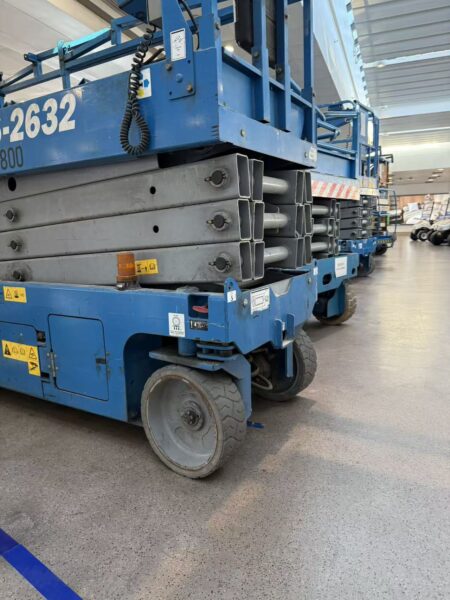
Cost Analysis: Solid vs Pneumatic Over 3 Years
Consider a fleet of 10 scissor lifts operating on a construction site with moderate debris exposure:
| Cost Factor (per tire, 3-year period) | Solid Tires | Pneumatic Tires |
| Initial tire cost | $180 | $75 |
| Number of replacements (3 years) | 1 (at ~3,500 hrs) | 3 (at ~1,200 hrs avg) |
| Total tire purchase cost (3 years) | $180 | $225 |
| Flat repairs (patches/plugs) | $0 | 45 (est. 3 flats × 15) |
| Downtime cost (flats only) | $0 | 300 (est. 3 flats × 100/hr × 1 hr) |
| Pressure check labor (5 min/day × 250 days × 3 yrs) | $0 | 63 (est. 0.05/min) |
| Total 3-year cost per tire | $180 | $633 |
| Total 3-year cost per machine (4 tires) | $720 | $2,532 |
| Total 3-year cost for 10-machine fleet | $7,200 | $25,320 |
Note: Costs are illustrative estimates; actual costs vary by tire size, brand, and local labor rates.
The math is clear: even though solid tires cost 2.4× more upfront, they save approximately 72% of total tire-related costs over a 3-year period in debris-rich environments — primarily through eliminated downtime and reduced replacement frequency.
FAQ: Solid vs Pneumatic Scissor Lift Tires
Q1: Can I put solid tires on a scissor lift that came with pneumatic tires?
In many cases, yes — but you must verify rim compatibility, overall diameter match (within ±3%), and load capacity. Some scissor lift rims are designed specifically for pneumatic beads and will not accept solid tire bands. Always consult the equipment manual or a tire specialist before converting.
Q2: Do solid tires make a scissor lift less stable?
No — solid tires actually improve stability. Because solid tires deflect less under load than pneumatic tires, the machine sits more firmly on its tires with less lateral sway. This is particularly important when the platform is fully elevated, where tire squirm on pneumatics can make the platform feel less secure.
Q3: How long do solid scissor lift tires last compared to pneumatic?
Solid scissor lift tires typically last 3,000–5,000+ operating hours, while pneumatic tires on the same machine last 1,000–2,500 hours. The exact life depends on operating surface, load frequency, and debris exposure. In high-debris environments, pneumatic tires may fail well before their tread wears out due to punctures.
Q4: Are foam-filled tires better than solid tires for scissor lifts?
It depends on your priority. Foam-filled tires offer ride quality and traction closest to pneumatic tires while being puncture-proof. Solid tires offer longer wear life and maximum stability but a firmer ride. If your scissor lift operates outdoors on rough terrain, foam-filled is usually the better choice. If it operates primarily indoors or on finished surfaces, solid is preferable.
Q5: Will solid tires damage my scissor lift’s suspension or components?
Properly sized solid tires do not damage equipment. However, solid tires transmit more vibration than pneumatic tires, which can accelerate wear on wheel bearings, bushings, and certain drivetrain components on machines not originally designed for solid tires. If this is a concern, foam-filled tires provide a cushioned alternative.
Q6: Can I use non-marking solid tires outdoors?
Yes, but they are not ideal for rough outdoor terrain. Non-marking compounds are typically softer than standard black compounds, which means they wear faster on abrasive outdoor surfaces. If your scissor lift splits time between indoor and outdoor use, consider non-marking foam-filled tires, which combine a non-marking tread with outdoor-capable construction.
Q7: How do I know when to replace scissor lift tires?
Replace scissor lift tires when you observe any of the following: tread worn to the wear indicator line, exposed cords or fabric, chunks missing from the tread, cracks or splits in the sidewall, uneven wear causing the machine to sit unlevel, or (for pneumatic tires) repeated slow leaks that cannot be repaired. For solid tires, the primary indicator is tread wear to the replacement line.
Q8: Where can I buy solid or foam-filled tires for my scissor lift fleet?
Kebek Tire manufactures a full range of solid, pneumatic, and foam-filled tires for scissor lifts in sizes compatible with all major brands (JLG, Genie, Skyjack, Haulotte, Snorkel, and more). We offer standard black, non-marking, and traction-tread compounds. [Reach out for a consultation] and our team will help you select the right tire type and size for your scissor lifts and operating conditions.
Conclusion: Which Should You Choose?
The solid vs pneumatic decision for scissor lifts comes down to one fundamental question: Where does your machine spend most of its time?
| If Your Scissor Lift Operates… | Best Tire Choice | Why |
| Primarily indoors (warehouse, factory, retail) | Solid (non-marking) | Zero maintenance, maximum stability, no floor marks |
| On construction sites with heavy debris | Solid or foam-filled | Puncture-proof; eliminates flat-tire downtime |
| Outdoors on rough terrain | Pneumatic or foam-filled | Best traction and ride comfort on uneven ground |
| Mixed indoor/outdoor | Foam-filled | Puncture-proof with pneumatic-level ride comfort |
| In 24/7 multi-shift operations | Solid | Zero maintenance; always ready to run |
| On tight upfront budget | Pneumatic | Lowest initial cost (but higher long-term TCO) |
The bottom line: For the majority of scissor lift applications — especially indoor, construction, and high-debris environments — solid tires are the better long-term choice. They last 2–3× longer, eliminate flat-tire downtime entirely, require zero maintenance, and provide superior stability at height. The higher upfront cost is recovered within the first replacement cycle and continues to generate savings over the tire’s life.
For rough-terrain outdoor applications where traction and ride comfort are essential, foam-filled tires are the smart compromise — puncture-proof with pneumatic performance.
If you’d like help assessing your scissor lift fleet and selecting the right tire for each machine’s operating environment, [reach out for a consultation]. Our specialists will recommend the optimal tire type, compound, and size — and provide a fleet-level cost comparison tailored to your operations.
[External Link to: Kebek Tire Made-in-China Store — https://offtheroadtire.com/— Browse our complete solid tire, scissor lift tire, and foam-filled tire catalog] [External Link to: Kebek Tire Alibaba Store — https://www.alibaba.com/product-detail/High-quality-wheel-loader-tires-23_60779164970.html — Explore solid and aerial lift tires on Alibaba.com]