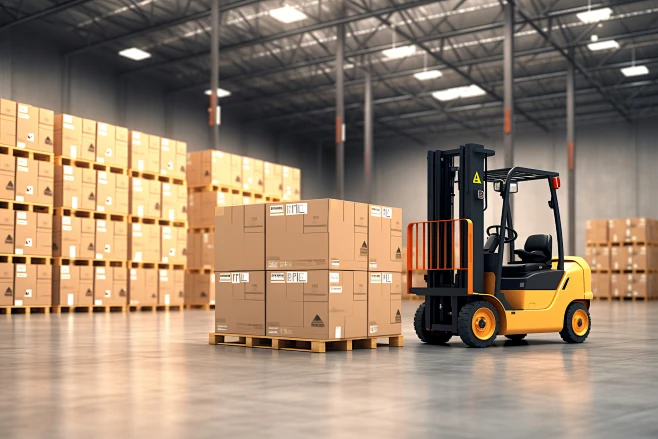
Forklift tire selection has a step that most buyers skip — and skipping it is why so many forklifts end up on the wrong tires entirely. Before comparing solid against pneumatic, there is a gating question: what kind of forklift do you have? A cushion (pad) forklift and a pneumatic-chassis forklift are different machines, built around different wheels, and only one of them gives you a real choice.
Get that right first, and the solid-versus-pneumatic question answers itself more often than you would expect. This guide walks the decision in the correct order: chassis type, then tire category, then the comparison that actually applies to your operation.
Scope note: this article covers standard counterbalance warehouse and yard forklifts — the 1.5–8 t class working distribution centers, factories, and logistics yards. For heavy port equipment (reach stackers, empty-container handlers on 16.00-25 class tires), the selection logic differs and is covered in our port equipment tire guide.
Step One: Your Forklift’s Chassis Decides Your Options
This is the fact that reorganizes the entire question:
| Chassis type | What it is | Tire options |
| Cushion (pad) forklift | Compact, low-profile design built for smooth indoor concrete; smaller wheels, tighter turning radius | Press-on solid tires only — the chassis is engineered around them |
| Pneumatic-chassis forklift | Larger, higher-clearance design for mixed indoor/outdoor work; accepts conventional wheels | Pneumatic (air) tires, or solid industrial tires on the same rims, or foam-filled conversions |
If you operate a cushion forklift, the solid-vs-pneumatic debate is over before it starts: your machine takes press-on solids, full stop. The interesting question — and the one this article’s comparison section answers — belongs to pneumatic-chassis forklifts, where all three categories are physically possible.
Not sure which chassis you have? Look at the wheel: a slim tire mounted directly onto a steel band (no separate rim on most designs) is press-on; a conventional tire on a bolted rim means a pneumatic chassis.
The Three Categories, Plus One Hybrid
Press-on solid tires (cushion forklifts)
A press-on tire is rubber molded directly onto a steel band that is pressed — hence the name — onto the wheel hub. Typical markings read 28x12.5-15 (outer diameter × width × band diameter in inches). They deliver high load capacity in a small envelope, never go flat, and enable the cushion truck’s tight warehouse geometry. Our solid tire range covers the common press-on sizes.
Solid industrial tires (pneumatic-chassis forklifts)
A conventional-diameter solid tire with an aperture (holes) design that mounts on standard rims in industrial sizes such as 6.50-10, 7.00-12, 8.25-15. It gives pneumatic-chassis trucks press-on-style puncture immunity while keeping the larger footprint and ground clearance of a pneumatic machine.
Pneumatic tires (air-filled)
Air-inflated tires in the same industrial sizes, bias or radial construction. They absorb shock, grip uneven and outdoor surfaces, and ride gently — at the cost of puncture exposure, pressure maintenance, and lower load capacity per size. Load/inflation relationships follow the standardized industrial tables published by TRA and ETRTO.
Foam-filled (the hybrid)
A pneumatic casing filled with polyurethane elastomer instead of air. Puncture-proof like a solid, with some of the pneumatic’s shock absorption — but heavier than either, harder on the fuel system and load rating, non-repairable, and with the casing’s life limited by the fill. It is a targeted solution, not a default; the economics trade-offs that Tyrepress and the industry press track consistently show foam-fill paying off mainly on puncture-plagued outdoor yards, not smooth indoor floors.
The Comparison: Solid vs Pneumatic on a Pneumatic Chassis
| Dimension | Solid industrial tire | Pneumatic tire |
| Puncture risk | Zero | Real — the #1 unscheduled downtime source |
| Load capacity (same size) | Higher | Lower (air-supported structure) |
| Shock absorption | Minimal — vibration passes to truck, load, and operator | Good — protects goods, mast, and operator |
| Floor requirements | Needs reasonably smooth concrete; punishes expansion joints and cracks at speed | Tolerates rougher surfaces, dock plates, uneven yards |
| Outdoor / yard use | Possible but hard on the machine and the tire wears fast on abrasive asphalt | Better traction and comfort on outdoor surfaces |
| Service life | Long — typically 2–4× pneumatic life on the same duty | Shorter, and cut/puncture shortens it unpredictably |
| Maintenance | None (no pressure checks) | Pressure checks required; underinflation causes rapid casing failure |
| Initial price | Higher | Lower |
| Cost per hour | Usually lower in high-shift operations | Lower only in light-duty or low-shift operations |
| Ride quality / operator fatigue | Noticeably harsher, especially over dock bumps | Significantly better |
Read the load row carefully: it is why high-throughput distribution centers run solids even on pneumatic-chassis trucks — the same truck simply carries more on solid tires, and it never stops for a flat.
Decision Table: Which One Do You Need?
| Your operation | Best choice | Why |
| Cushion forklift, indoor concrete | Press-on solid | The chassis offers no alternative — and it is ideal for this duty |
| High-shift (2–3 shifts/day) indoor logistics on good concrete | Solid industrial | Uptime and load capacity dominate; life cycle cost wins |
| Mixed indoor + outdoor yard, dock plates, cracked pavement | Pneumatic | Shock absorption protects the truck and the load; comfort matters |
| Puncture-plagued outdoor yard (nails, steel debris, slab damage) | Foam-filled or solid | Converting the fleet from flat-prone pneumatics pays back fast |
| Light-duty, single-shift, smooth dedicated floor | Pneumatic | Cheapest entry; duty does not justify solids’ premium |
| Fragile or high-value cargo | Pneumatic | Softer ride transmits less shock into the load |
| Cold storage and food/pharma clean floors | Non-marking solid compounds | Uptime plus floor marking rules — see our forklift tire options for compound availability |
The pattern in that table is the whole answer in one sentence: solids buy uptime and load; pneumatics buy comfort and forgiveness. Everything else is arithmetic about your shifts and your floors.
Five Mistakes That Cost Money
1. Treating “solid is more expensive” as the end of the math. The purchase price is higher; the cost per operating hour usually is not, once puncture downtime, pressure labor, and replacement frequency are counted. Fleets that compare only the invoice price consistently over-buy pneumatics for heavy-duty work.
2. Running solids on floors that cannot take them. Solids do not absorb shock — the floor condition passes straight into the truck, the mast, and the goods. On badly cracked slabs and rough dock approaches, solids damage the machine they were supposed to serve.
3. Foam-filling as a blanket policy. Foam-fill solves punctures, but it adds rotating mass, reduces effective load capacity, and cannot be repaired or re-filled. It earns its cost on puncture-heavy yards; on smooth indoor floors it is simply a more expensive solid with none of the benefits.
4. Ignoring the load rating when converting. Converting a pneumatic-chassis truck from pneumatics to solids (or foam-fill) changes effective load behavior. Verify the new configuration against the truck’s data plate and the tire’s rated capacity — the same physical size can carry different loads by category, per the TRA and ETRTO industrial tables.
5. Buying on price without checking the compound. Solid tire life is largely a compound story — heat-resistant compounds for intense cycle work, standard compounds for lighter duty, non-marking compounds where floors demand them. Two visually identical solids can differ by multiples in service life; evaluating suppliers on compound options and technical data, as covered in our supplier selection guide, matters more for solids than for any pneumatic purchase.
Frequently Asked Questions
Which is better, solid or pneumatic forklift tires?
Neither, universally. Solids win on uptime, load capacity, and lifetime cost in high-shift indoor work; pneumatics win on ride quality, outdoor versatility, and purchase price in mixed or lighter duty. Your chassis type, floor condition, and shift pattern decide — the decision table above maps the common cases.
Can I put solid tires on a forklift that came with pneumatics?
On a pneumatic-chassis forklift, yes — solid industrial tires are made in the same conventional sizes and mount on the same rims. Verify the load rating and expected floor conditions first. On a cushion (pad) forklift the question does not arise: it only accepts press-on solids.
Can I put air tires on a cushion forklift?
No. Cushion forklifts are engineered around press-on solid tires — the chassis, axle, and brakes assume their dimensions and weight. There is no pneumatic option for a cushion truck.
Why are solid forklift tires so expensive compared to pneumatic?
More rubber, higher-density compounds, and steel band construction. The premium is repaid through service life (typically 2–4× pneumatic) and zero puncture downtime — which is why the higher sticker price usually wins on cost per hour in anything beyond light duty.
Do solid forklift tires damage the forklift?
Not on the floors they are designed for. On rough floors, dock plates, and cracked slabs, the vibration solids transmit (instead of absorbing) accelerates wear on the mast, the electrical compartment, and the operator’s comfort. Match the tire to the floor, not the other way round.
What is a foam-filled forklift tire?
A pneumatic tire filled with polyurethane elastomer instead of air. It combines puncture immunity with part of the pneumatic ride, at the cost of extra weight, reduced effective load capacity, and no repairability. Best for puncture-plagued outdoor yards; unnecessary on smooth indoor floors.
How long do solid forklift tires last?
Commonly two to four times the life of pneumatics in the same application — but the real answer depends on duty cycle, floor quality, and compound. Our companion article (coming in this series) covers solid tire lifespan and the 60–70% wear replacement rule in detail.
Are non-marking tires always solid?
No — non-marking compounds exist in both solid and pneumatic tires. In practice, clean-floor facilities usually pair non-marking requirements with solid tires for the uptime, but the compound decision and the category decision are independent. Compound availability is listed in our forklift tire range.
Summary: The Decision in Five Steps
- Identify your chassis. Cushion → press-on solids, no debate. Pneumatic chassis → all three categories possible.
- Rate your floors. Smooth concrete favors solids; rough, outdoor, or mixed surfaces favor pneumatics.
- Count your shifts. High-shift operations almost always land on solids for uptime and cost per hour; light duty can stay pneumatic.
- Weigh the cargo. Fragile or high-value loads ride better on air.
- Special-case puncture yards with foam-fill — and clean-floor operations with non-marking compounds.
Matching the category to the machine and the duty is what separates a tire budget from a tire strategy. For compound options, sizes, and stock positions across both solid and pneumatic ranges, browse the forklift tire lineup or send us your forklift models and floor conditions — we will map the exact fit.