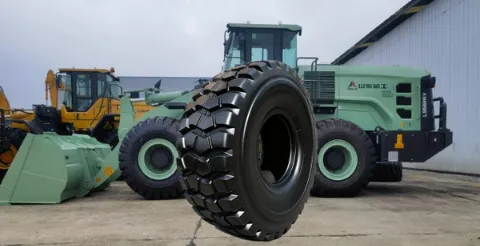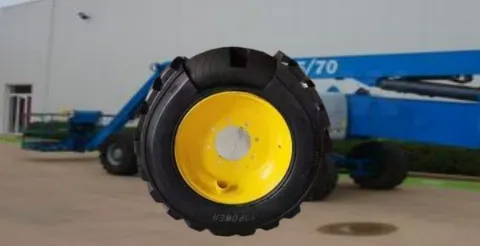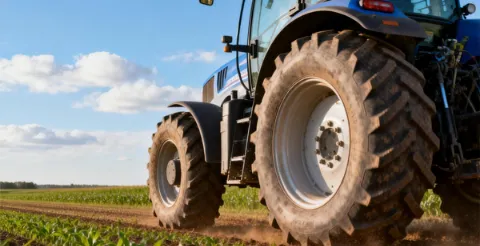
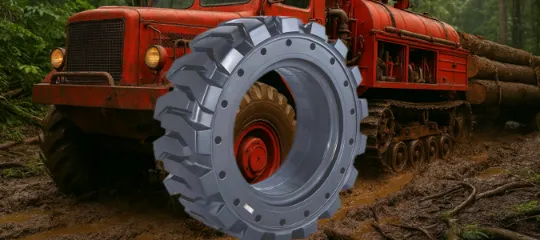
Large solid tires play a decisive role in the development of a new half track vehicle platform, for which the platform manufacturer chose to source directly from our company as a dedicated OEM supplier. Built for off road traction, puncture-proof construction, and the extreme demands placed on modern forestry vehicle tires, these solid tires allow the machine to operate where ordinary setups fail. With wildfire response routes becoming steeper, softer, and more unpredictable every year, new half track vehicles need a tire system that could maintain stability and reliability in burned terrain – and that upgrade begins from the ground up with our engineered large solid tires designed for the harshest environments.
Why Half Track Designs Are Gaining Momentum
Half track systems combine the best traits of wheels and tracks. They float over loose soil and ash, maintain strong traction on steep hills, and keep the vehicle stable even when the ground is wet, uneven, or filled with debris. Compared with a traditional wheeled setup, half tracks distribute weight more evenly and reduce sinkage – an essential benefit in wildfire zones or muddy logging areas. And unlike full track systems, half tracks remain easier to drive, maintain, and repair in the field.
The Harsh Conditions of Modern Forestry and Firefighting
Forestry equipment and wildfire response vehicles work in terrains that destroy ordinary tires:
- Roots, stumps, and jagged volcanic stone
- Burned nails, metal fragments, and hot embers
- Heavy loads during tree pulling, water transport, or winching
- Continuous heat cycles during firefighting operations
- Soft, unstable soil after seasonal rain or post-fire erosion
Pneumatic tires routinely suffer punctures, sudden failures, and downtime in such environments. For fleets, every hour of delay can mean lost equipment, delayed containment, or increased operational risk.
Why Large Solid Tires Became the Manufacturer’s Choice
To guarantee reliability in every condition, the vehicle manufacturer selected a new line of high-capacity, large-diameter solid tires. These solid tires eliminate air pressure entirely, meaning they cannot puncture, blow out, or leak. For mission-critical operations — especially where vehicles must drive through burning debris — this is a huge advantage.
Key reasons for choosing solid tires include:
- Zero punctures in sharp or burnt environments
- High load capacity suitable for half track front modules
- Stiff sidewalls that stabilize the vehicle on slopes
- Heat-resistant compounds for wildfire zones
- Long, predictable service life that lowers fleet cost
For firefighting units and forestry operators, reliability isn’t just convenient — it’s essential.
Technical Features That Stand Out
The new solid tires are engineered specifically for half track needs:
- Large diameter & wide section for stable front-end flotation
- Reinforced bead seats compatible with heavy half track hubs
- Deep, self-cleaning tread designed for mud, clay, and ash
- High-elastic rubber layers to reduce shock and vibration
- Optional non-marking and high-traction compounds
Even though solid tires are traditionally known for stiffness, this new generation uses improved rubber elasticity to soften impacts and maintain operator comfort.
How These Tires Elevate Half Track Performance
Once integrated into the half track system, the solid tires transform overall vehicle performance:
- Better flotation in soft soil or burned forest floors
- Smoother contact with the track system for improved traction
- Greater hillside stability during logging and rescue operations
- Safe operation near hotspots without fear of blowouts
- Minimal downtime due to maintenance-free tire construction
For fleets working in demanding terrain, this combination provides a measurable improvement in response speed, reliability, and long-term cost control.
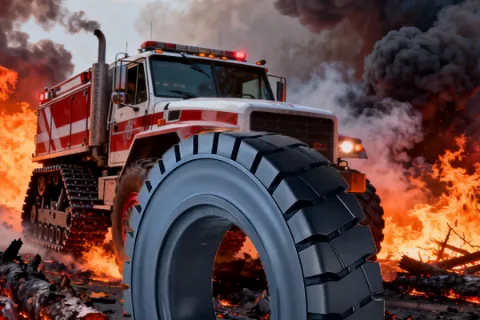
Real Use Scenarios from Field Testing
During early trials, the half track vehicle was tested across tough environments:
- Deep-mud tropical forestry where traditional wheels sink rapidly
- Burned mountain terrain filled with sharp charcoal and metal scraps
- High-slope logging routes where stability determines safety
- Wet ash-covered surfaces common after wildfire suppression
Operators consistently reported better front-end stability and complete elimination of tire-related downtime.
A Strong Advantage for Importers and Distributors
In markets such as Southeast Asia, Africa, and South America — where forestry, plantation management, and wildfire response are daily realities — demand for reliable off-road vehicles is growing fast. Importers and distributors benefit from:
- Fewer after-sales complaints (no punctures, no pressure loss)
- A more durable, premium product to position in competitive markets
- Lower fleet maintenance costs that customers appreciate
- A unique selling point: half track traction + solid tire reliability
This new vehicle offers a compelling solution for customers who depend on uninterrupted performance.
For readers who also handle warehouse fleets or heavy material-handling equipment, you may find this related article useful: Solid Industrial Tires for Forklifts & Material Handling
Conclusion
The development of the new half track forestry and firefighting vehicle shows how innovation and durability can work together. By pairing a modern half track design with large solid tires, the manufacturer has created a machine capable of thriving in the most extreme conditions nature can offer. For operators, fleets, and importers, this combination delivers reliability, safety, and performance that standard vehicles simply cannot match.